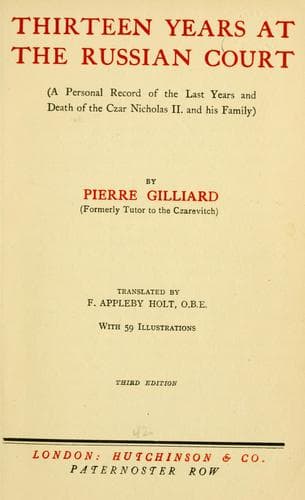
Thirteen years at the Russian court: (a personal record of the last years and death of the Czar Nicholas II. and his family)Gilliard, Pierre
History
Thirteen years at the Russian court: (a personal record of the last years and death of the Czar Nicholas II. and his family)
Gilliard, Pierre
Nicholas II, Emperor of Russia, 1868-1918; Romanov, House of; Soviet Union -- History -- Revolution, 1917-1921 -- Personal narratives
The Czarina had devoted herself to the cause of the wounded from the
start, and she had decided that the Grand-Duchesses Olga Nicolaïevna and
Tatiana Nicolaïevna should assist her in her task. All three of them
took a course in nursing, and passed several hours of every day caring
for the wounded who were sent to Tsarskoïe-Selo. Her Majesty, sometimes
with the Czar and sometimes alone with her two daughters, paid several
visits to the Red Cross establishments in the towns of Western and
Central Russia. At her suggestion, many military hospitals had been
organised, as well as ambulance trains specially fitted up for the
evacuation of the wounded to the rear, a process which was often very
slow owing to the immense distances. Her example had been followed, and
private initiative had never been displayed with the same enthusiasm and
generosity.
Lastly a congress of all the _zemstvos_[35] and the municipalities of
Russia had assembled in Moscow to organise the resources of the country.
Under the influence of energetic and disinterested individuals the
congress had rapidly been converted into a potent piece of machinery,
with immense resources at its command and in a position to give the
Government the most valuable help.
In its scope and the patriotic fervour behind it this movement had been
unprecedented in Russian history. The war had become a truly national
war.
The month of September had been marked for Russia by alternating
victories and reverses. In East Prussia the defeat of Tannenberg had
been followed by that of the Masurian Lakes, where the superiority of
the Germans had been demonstrated once again. In Galicia, on the other
hand, the Russians had captured Lemberg, and continued their
irresistible advance, inflicting serious losses on the Austrian army,
which had fallen back into the Carpathians. In the following month the
Germans tried to secure Warsaw, but their furious onslaught had been
broken against the splendid resistance of the Russians. The losses on
both sides had been heavy.
In December the Czar paid a visit to the Caucasus, where the Southern
Army was operating. He was anxious to spend a little time with the
troops who were fighting under the most trying conditions against the
Turkish divisions massed on the Armenian frontier. On his return he
joined the Czarina at Moscow, and the children also were brought there
to meet him. The Czar visited the military schools and with Her
Majesty, his son and daughters, several times made the rounds of the
hospitals and nursing establishments in that city.
During the five days we spent at Moscow the enthusiasm of the people had
been every bit as great as in August, and it was with real regret that
Their Majesties left the ancient capital of Muscovy, the Czar leaving
for G.H.Q. and the other members of the family returning to
Tsarskoïe-Selo.
Public-domain text, read in full here on John Shaqi.
Reviews
Reviews
No reviews yet
Be the first to share your thoughts on this work.
Join the Discussion
Join the discussion
Sign in to leave a comment or review.
Sign InorCreate an account