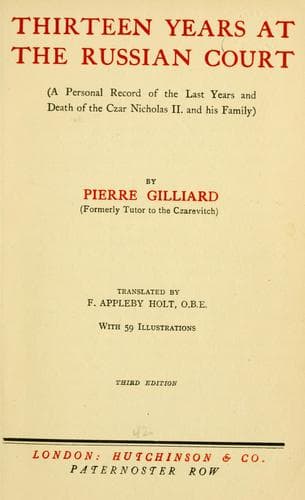
Thirteen years at the Russian court: (a personal record of the last years and death of the Czar Nicholas II. and his family)Gilliard, Pierre
History
Thirteen years at the Russian court: (a personal record of the last years and death of the Czar Nicholas II. and his family)
Gilliard, Pierre
Nicholas II, Emperor of Russia, 1868-1918; Romanov, House of; Soviet Union -- History -- Revolution, 1917-1921 -- Personal narratives
In the first place the Czar believed that his cause was a holy cause.
The events of the end of July had enabled him to see through the
duplicity of Germany to which he had nearly fallen a victim. He also
felt that he had never been so near to his people. He seemed to be borne
along by them. His journey to Moscow had shown him how popular the war
was and how much the nation appreciated the fact that his firm and
dignified attitude had enhanced its prestige in the eyes of the outside
world. The enthusiasm of the masses had never before been demonstrated
with the same spontaneous fervour. He felt that he had the whole country
behind him, and he hoped that political passion, which had vanished in
the presence of the common peril, would not revive so long as the war
was in progress.
The disaster of Soldau, in East Prussia, occurred a few days after his
arrival in Moscow, but it had not shaken his confidence. He knew the
cause of that terrible defeat had been that the concentration of the
troops had not been complete, and that General Samsonoff’s army had had
to advance into German territory too fast in order to attract some of
the enemy forces to itself and thus relieve the Western Front. That
defeat had had its compensation a week later in the victory of the
Marne. It was not right to bewail a sacrifice which had saved France and
therefore ultimately Russia herself. It is true that the same result
could have been obtained with less loss and that the Russian High
Command was not free from blame, but this was one of the misfortunes
which are always possible in the early days of a campaign.
The Czar thus preserved all his confidence and energy. At the very
beginning of the war, and notwithstanding the opposition of many
influential people, he had prohibited the production and sale of
spirits. The step meant a serious loss to the Treasury, and that at a
time when money was wanted more than ever. But his faith had been
stronger than all the objections which had been urged. He had also acted
personally in endeavouring to replace all unpopular Ministers by men who
seemed to have the confidence of the Duma. In that way he desired to
emphasise his wish for closer collaboration with the representatives of
the people.
On October 3rd the Czar had gone to G.H.Q., where he spent three days.
Then after a short visit to the troops in the region of Brest and Kovno,
he had returned to Tsarskoïe-Selo.
Henceforth he made periodic visits to the front and the interior of the
country, seeing the different sectors of the immense front, the clearing
stations and military hospitals, the factories and, in fact, everything
which played any part in the conduct of the terrible war.
Public-domain text, read in full here on John Shaqi.
Reviews
Reviews
No reviews yet
Be the first to share your thoughts on this work.
Join the Discussion
Join the discussion
Sign in to leave a comment or review.
Sign InorCreate an account