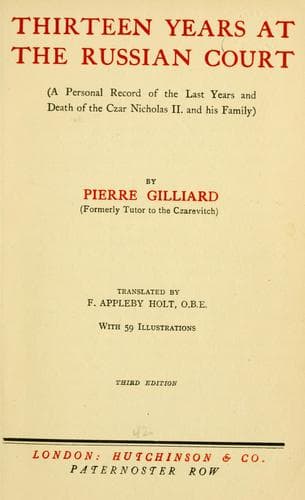
Thirteen years at the Russian court: (a personal record of the last years and death of the Czar Nicholas II. and his family)Gilliard, Pierre
History
Thirteen years at the Russian court: (a personal record of the last years and death of the Czar Nicholas II. and his family)
Gilliard, Pierre
Nicholas II, Emperor of Russia, 1868-1918; Romanov, House of; Soviet Union -- History -- Revolution, 1917-1921 -- Personal narratives
My particular anxiety, however, was to find companions for the Imperial
Heir. This was a problem most difficult to solve. Fortunately
circumstances themselves conspired to make good this deficiency to a
certain extent. Dr. Derevenko had a son who was almost the same age as
Alexis Nicolaïevitch. The two boys got to know each other, and were soon
good friends. No Sunday, _fête_ day or holiday passed without them
meeting. They were together every day ultimately, and the Czarevitch
even obtained permission to visit the house of Dr. Derevenko, who lived
in a little villa not far from the palace. He often spent whole
afternoons there with his friend and playmate in the modest home of a
_bourgeois_ family. There was a good deal of criticism of this
innovation, but Their Majesties would not interfere. They were so
unaffected in their own private life that they could not but encourage
the same tastes in their children.
Yet the war had already brought some very remarkable change in our life
at the palace. It had always been austere, and now became even more so.
The Czar was away a good deal. The Czarina and her two elder daughters
almost always wore the costume of a nurse, and divided their time
between visits to the hospitals and the innumerable duties arising out
of their work for the relief of the wounded. The Czarina was very tired
even when the war began. She had spent herself without counting the
consequences, devoting herself with the enthusiasm and ardour she
brought to everything to which she set her hand. Although her health was
severely shaken, she displayed remarkable physical elasticity. She
seemed to derive comfort and strength from the accomplishment of the
splendid task which she had undertaken. It was as if she found that it
satisfied her craving for self-devotion and enabled her to forget the
poignant anxiety and apprehension that the Czarevitch’s illness caused,
even in its inactive periods.
Another result of the war, as agreeable as unexpected, was that Rasputin
had retired into the background. At the end of September he had returned
from Siberia completely recovered from the terrible wound which had all
but ended his days. But everything pointed to the fact that since his
return he was being more or less neglected. In any case, his visits were
more and more infrequent. It was true that as Alexis Nicolaïevitch had
been so much better during the winter there had been no need to resort
to his intervention, so that he had found himself deprived of what had
been his great stand-by.
Public-domain text, read in full here on John Shaqi.
Reviews
Reviews
No reviews yet
Be the first to share your thoughts on this work.
Elsewhere in the archive
Join the Discussion
Join the discussion
Sign in to leave a comment or review.
Sign InorCreate an account