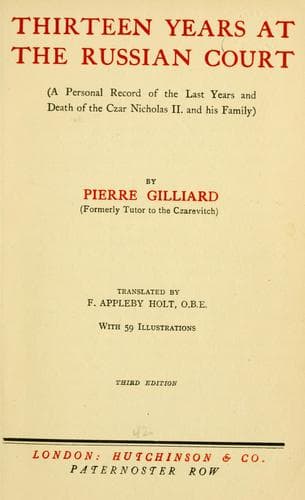
Thirteen years at the Russian court: (a personal record of the last years and death of the Czar Nicholas II. and his family)Gilliard, Pierre
History
Thirteen years at the Russian court: (a personal record of the last years and death of the Czar Nicholas II. and his family)
Gilliard, Pierre
Nicholas II, Emperor of Russia, 1868-1918; Romanov, House of; Soviet Union -- History -- Revolution, 1917-1921 -- Personal narratives
But when all is said, his power remained quite formidable. I had proof
of the fact a short time after, when Madame Wyroubova was all but killed
in a terrible railway accident. She was nearly dead when she was dragged
from under the fragments of a shattered carriage, and had been brought
to Tsarskoïe-Selo in a condition which seemed desperate. In her terror
the Czarina had rushed to the bedside of the woman who was almost her
only friend. Rasputin, who had been hastily sent for, was there also. In
this accident the Czarina saw a new proof of the evil fate which seemed
to pursue so relentlessly all those whom she loved. As she asked
Rasputin in a tone of anguish whether Madame Wyroubova would live, he
replied:
“God will give her back to you if she is needed by you and the country.
If her influence is harmful, on the other hand, He will take her away. I
cannot claim to know His impenetrable designs.”
It must be admitted that this was a very clever way of evading an
awkward question. If Madame Wyroubova recovered he would have earned her
eternal gratitude, as, thanks to him, her recovery would seem to
consecrate, as it were, her mission with the Czarina. If she died, on
the other hand, Her Majesty would see in her death a manifestation of
the inscrutable ways of Providence, and thus be the more easily consoled
in her loss.[36]
Rasputin’s intervention had helped him to recover his influence, but his
triumph was short-lived. In spite of everything, we felt that something
had changed, and that he was not so important as he had been. I was
delighted to note the fact, particularly as shortly before I had had a
long talk on the subject of the _staretz_ with the Swiss Minister in
Petrograd.[37] The information he gave me in the course of our
conversation left me in no doubt as to the real character of Rasputin.
As I had always suspected, he was a misguided mystic who possessed a
kind of psychic power, an unbalanced creature who worked alternately
through his carnal desires and his mystic visions, a being quite capable
of having weeks of religious ecstasy after nights of infamy. But before
this interview I had never realised the importance that was attached to
Rasputin’s influence on politics, not merely in Russian circles, but
even in the embassies and legations of Petrograd. That influence was
greatly exaggerated, but the mere fact that it could exist was a kind of
challenge to public opinion. The presence of this man at Court was also
a subject of mystery and abhorrence to all who knew the debauchery of
his private life. I fully realised that all this involved the greatest
danger to the prestige of Their Majesties and furnished a weapon which
their enemies would sooner or later try to use against them.
Public-domain text, read in full here on John Shaqi.
Reviews
Reviews
No reviews yet
Be the first to share your thoughts on this work.
Elsewhere in the archive
Join the Discussion
Join the discussion
Sign in to leave a comment or review.
Sign InorCreate an account