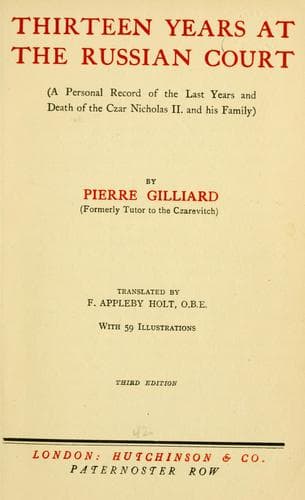
Thirteen years at the Russian court: (a personal record of the last years and death of the Czar Nicholas II. and his family)Gilliard, Pierre
History
Thirteen years at the Russian court: (a personal record of the last years and death of the Czar Nicholas II. and his family)
Gilliard, Pierre
Nicholas II, Emperor of Russia, 1868-1918; Romanov, House of; Soviet Union -- History -- Revolution, 1917-1921 -- Personal narratives
The Austrians were the first to take the offensive, but the Russians
counter-attacked vigorously, and their superiority was soon made
manifest all along the front. In the first fortnight of March their
successes were continued. On the 19th they captured the fortress of
Przemysl. The whole garrison and considerable booty in war material fell
into their hands. There was tremendous excitement in the country. The
Czar returned from G.H.Q. on March 24th. He was in high spirits. Were
the fortunes of war at length going to turn in favour of Russia?
In the middle of April Russian divisions stood on the crest of the
Carpathians and menaced the rich plains of Hungary. The Austrian army
was at the end of its tether. But these successes had been bought at the
price of enormous losses, and the mountain fighting continued under
conditions which were extremely trying even for the victor. The
prolongation of the war was also beginning to show effects on the
population at home. It had begun to feel the high cost of food and the
poverty of communications was paralysing all economic life. There must
be no delay in finding a solution.
But Germany could not remain indifferent to the dissolution of the
Austrian army, and as soon as she clearly appreciated the danger she
made up her mind to avert it by taking every step in her power. Several
German army corps had been massed east of Cracow and placed under the
command of General Mackensen, who was to take the offensive against the
flank of the Russian army and try to cut the communications of the
troops operating in the Carpathians. The onslaught began in the first
days of May, and under the pressure of the Germans the Russian army of
Western Galicia was obliged to retreat rapidly to the east. It had to
accept the loss of the Carpathians, the capture of which had cost so
much blood and effort, and descend into the plains. The troops fought
with remarkable courage and endurance, but they were cruelly short of
arms and ammunition.
The retreat continued. On June 5th Przemysl was lost, and on June 22nd
Lemberg. By the end of the month all Galicia--that Slav land the
conquest of which had filled all Russian hearts with joy--had been
evacuated.
[Illustration: THE CZAR.]
[Illustration: THE CZAREVITCH.
_Facing page 134._]
Meanwhile the Germans had begun a vigorous offensive in Poland and made
rapid progress in spite of the fierce resistance of the Russians. It was
a grave moment. The whole Russian front had been shaken and given way
under the pressure of the Austro-German armies. Men wished to know who
was responsible for these disasters. They called for the guilty and
demanded their punishment.
Public-domain text, read in full here on John Shaqi.
Reviews
Reviews
No reviews yet
Be the first to share your thoughts on this work.
Elsewhere in the archive
Join the Discussion
Join the discussion
Sign in to leave a comment or review.
Sign InorCreate an account