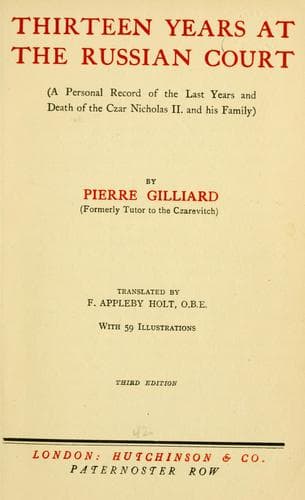
Thirteen years at the Russian court: (a personal record of the last years and death of the Czar Nicholas II. and his family)Gilliard, Pierre
History
Thirteen years at the Russian court: (a personal record of the last years and death of the Czar Nicholas II. and his family)
Gilliard, Pierre
Nicholas II, Emperor of Russia, 1868-1918; Romanov, House of; Soviet Union -- History -- Revolution, 1917-1921 -- Personal narratives
The development of events had been a terrible blow to the Czar. It had
been a shock, especially as he had certainly not expected anything of
the kind. But he set his teeth against adversity. On June 25th he
dismissed the Minister of War, General Sukhomlinoff, whose criminal
negligence seemed to have been responsible for the fact that it was
impossible to secure the army’s supplies. He replaced him by General
Polivanoff. On the 27th he summoned a conference at G.H.Q., at which all
the Ministers were present. It was a question of rousing all the
energies of the country, of mobilising all its forces and resources for
the life-and-death struggle with the hated foe.
It was decided to summon the Duma. The first sitting took place on
August 1st, the anniversary of the declaration of war by Germany on
Russia. The firm and courageous attitude of the Assembly did a good deal
to calm the public agitation. But while calling on the whole nation to
co-operate in the defence of the Fatherland, the Duma demanded that the
guilty should be discovered and punished. A few days later the Czar
appointed a “Commission of Enquiry” with a view to fixing responsibility
for the nation’s misfortunes.
Meanwhile the German offensive in Poland had made further progress. On
August 5th Warsaw was abandoned by the Russians, who withdrew to the
right bank of the Vistula. On the 17th Kovno was lost. One after the
other all the Russian fortresses fell before the onslaught of the enemy,
whose advance no obstacle seemed capable of staying. By the end of
August the whole of the Government of Poland was in the hands of the
Germans.
The reverses assumed the proportions of a catastrophe which endangered
the very existence of the country. Should we be able to stop the
invading hordes or should we have to follow the precedent of 1812 and
withdraw into the interior, thus abandoning Russian soil to the enemy?
Had all our willing sacrifices brought us nothing?
The country was suffering from the incessant withdrawals of men and from
requisitions. Agriculture was short of labour and horses. In the towns
the cost of living was rising with the disorganisation of the railways
and the influx of refugees. The most pessimistic news passed from mouth
to mouth. There was talk of sabotage, treason, etc. Russian public
opinion, so changeable and prone to exaggeration whether in joy or
sorrow, indulged in the most gloomy forebodings.
It was just when Russia was passing through this acute crisis that
Nicholas II. decided to take the command of his armies in person.
Public-domain text, read in full here on John Shaqi.
Reviews
Reviews
No reviews yet
Be the first to share your thoughts on this work.
Elsewhere in the archive
Join the Discussion
Join the discussion
Sign in to leave a comment or review.
Sign InorCreate an account