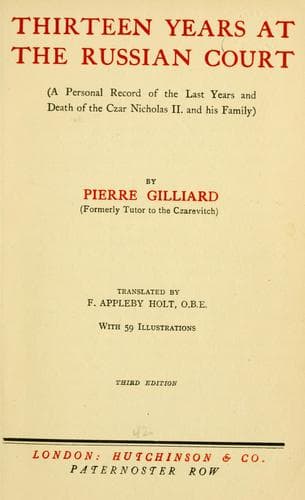
Thirteen years at the Russian court: (a personal record of the last years and death of the Czar Nicholas II. and his family)Gilliard, Pierre
History
Thirteen years at the Russian court: (a personal record of the last years and death of the Czar Nicholas II. and his family)
Gilliard, Pierre
Nicholas II, Emperor of Russia, 1868-1918; Romanov, House of; Soviet Union -- History -- Revolution, 1917-1921 -- Personal narratives
The next day we stopped at Riegitza, where the Czar wished to review
some troops which had been withdrawn from the front and were billeted in
the neighbourhood. All these regiments had taken part in the exhausting
campaigns in Galicia and the Carpathians, and their establishment had
been almost entirely renewed two or three times over. But in spite of
the terrible losses they had suffered, they marched past the Czar with a
proud and defiant bearing. Of course, they had been resting behind the
line for several weeks, and had had time to recover from their weariness
and privations. It was the first time that the Czar had passed any of
his troops in review since he had taken over the Command. They now
looked upon him both as their Emperor and Generalissimo. After the
ceremony he mixed with the men and conversed personally with several of
them, asking questions about the severe engagements in which they had
taken part. Alexis Nicolaïevitch was at his father’s heels, listening
intently to the stories of these men, who had so often stared death in
the face. His features, which were always expressive, became quite
strained in the effort not to lose a single word of what the men were
saying. His presence at the Czar’s side greatly interested the soldiers,
and when he had gone they were heard exchanging in a whisper their ideas
about his age, size, looks, etc. But the point that made the greatest
impression upon them was the fact that the Czarevitch was wearing the
uniform of a private soldier, which had nothing to distinguish it from
that of a boy in the service.
On October 16th we arrived at Mohileff, a little White Russian town of a
highly provincial appearance to which the Grand-Duke Nicholas had
transferred G.H.Q. during the great German offensive two months before.
The Czar occupied the house of the Governor, which was situated on the
summit of the steep left bank of the Dnieper. He was on the first floor
in two fairly large rooms, one of which was his study and the other his
bedroom. He had decided that his son should share his room. Alexis
Nicolaïevitch’s camp-bed was accordingly placed next to his father’s. I
myself and some members of the Czar’s military suite were lodged in the
local court-house, which had been converted for use by G.H.Q.
Our time was spent much as follows. Every morning at half-past nine the
Czar called on the General Staff. He usually stayed there until one
o’clock, and I took advantage of his absence to work with Alexis
Nicolaïevitch in his study, which we had been obliged to make our
workroom owing to lack of space. We then took lunch in the main room of
the Governor’s house. Every day there were some thirty guests, which
included General Alexeieff, his principal assistants, the heads of all
the military missions of the Allies, the suite, and a few officers who
were passing through Mohileff. After lunch the Czar dealt with urgent
business and then about three we went for a drive in a car.
Public-domain text, read in full here on John Shaqi.
Reviews
Reviews
No reviews yet
Be the first to share your thoughts on this work.
Elsewhere in the archive
Join the Discussion
Join the discussion
Sign in to leave a comment or review.
Sign InorCreate an account