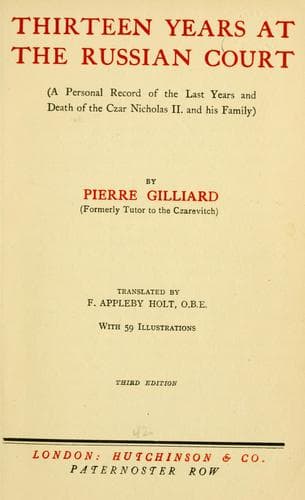
Thirteen years at the Russian court: (a personal record of the last years and death of the Czar Nicholas II. and his family)Gilliard, Pierre
History
Thirteen years at the Russian court: (a personal record of the last years and death of the Czar Nicholas II. and his family)
Gilliard, Pierre
Nicholas II, Emperor of Russia, 1868-1918; Romanov, House of; Soviet Union -- History -- Revolution, 1917-1921 -- Personal narratives
It was dark before the ceremony was over. On our return the Czar,
having heard from General Ivanoff that there was a casualty station
quite near, decided to visit it at once. We entered a dark forest and
soon perceived a small building feebly lit by the red flames of torches.
The Czar and Alexis Nicolaïevitch entered the house, and the Czar went
up to all the wounded and questioned them in a kindly way. His
unexpected arrival at so late an hour at a spot so close to the front
was the cause of the general astonishment which could be read on every
face. One private soldier, who had just been bandaged and put back in
bed, gazed fixedly at the Czar, and when the latter bent over him he
raised his only sound hand to touch his sovereign’s clothes and satisfy
himself that it was really the Czar who stood before him and not a
ghost. Close behind his father stood Alexis Nicolaïevitch, who was
deeply moved by the groaning he heard and the suffering he felt all
around him.
We rejoined our train and immediately left for the south. When we woke
next morning we were in Galicia. During the night we had crossed the
former Austrian frontier. The Czar was anxious to congratulate the
troops, whose prodigies of valour had enabled them to remain on hostile
soil notwithstanding the dearth of arms and ammunition. We left the
railway at Bogdanovka and gradually mounted the plateau on which units
from all the regiments of General Tcherbatcheff’s army had been
assembled. When the review was over the Czar disregarded the objections
of his suite and visited the Perchersky Regiment, three miles from the
front lines, at a place which enemy artillery fire could have reached.
We then returned to our cars, which we had left in a forest, and went to
General Lechitzsky’s army, which was some thirty miles away. We were
overtaken by darkness on our way back. A thick mist covered the
countryside; we lost our way and twice had to go back. But after many
wanderings we at length struck the railway again, though we were sixteen
miles from the place where we had left our train! Two hours later we
left for G.H.Q.
The Czar brought away a most encouraging impression from his tour of
inspection. It was the first time that he had been in really close
contact with the troops, and he was glad that he had been able to see
with his own eyes, practically in the firing-line, the fine condition of
the regiments and the splendid spirit with which they were inspired.
We returned to Mohileff in the evening of October 27th, and the next
morning Her Majesty and the Grand-Duchesses also arrived at G.H.Q.
During their journey the Czarina and her daughters had stopped at
several towns in the Governments of Tver, Pskoff, and Mohileff, in order
to visit the military hospitals. They stayed three days with us at
Mohileff and then the whole family left for Tsarskoïe-Selo, where the
Czar was to spend several days.
Public-domain text, read in full here on John Shaqi.
Reviews
Reviews
No reviews yet
Be the first to share your thoughts on this work.
Elsewhere in the archive
Join the Discussion
Join the discussion
Sign in to leave a comment or review.
Sign InorCreate an account