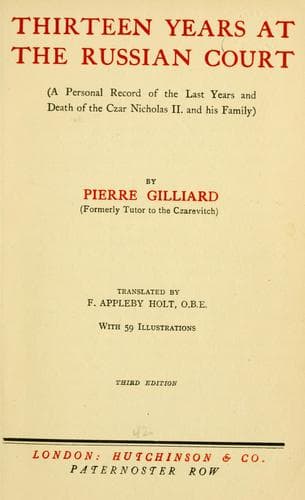
Thirteen years at the Russian court: (a personal record of the last years and death of the Czar Nicholas II. and his family)Gilliard, Pierre
History
Thirteen years at the Russian court: (a personal record of the last years and death of the Czar Nicholas II. and his family)
Gilliard, Pierre
Nicholas II, Emperor of Russia, 1868-1918; Romanov, House of; Soviet Union -- History -- Revolution, 1917-1921 -- Personal narratives
_Saturday, April 14th._--In the morning, at half-past nine, Mass
and Holy Communion. In the evening, at half-past eleven, everyone
went to church for the midnight service. Colonel Korovitchenko,
the Commandant of the palace and friend of Kerensky, and the three
officers of the guard were also present. The service lasted until
two o’clock, when we went to the library to exchange the
traditional greetings. The Czar, according to Russian custom,
embraced all the men present, including the Commandant and officers
of the guard, who had remained with him. The two men could not hide
their emotion at this spontaneous act.
We then took our places at a round table for the Easter meal. Their
Majesties sat facing one another. There were seventeen of us,
including the two officers. The Grand-Duchesses Olga and Marie were
not present, nor Alexis Nicolaïevitch. The comparative animation
which marked the beginning soon relapsed and conversation flagged.
His Majesty was particularly silent. Was it sadness or fatigue?
_Sunday, April 15th, Easter Day._--We went out for the first time
with Alexis Nicolaïevitch on the terrace in front of the palace. A
superb spring day.
In the evening at seven o’clock a religious service upstairs in the
children’s apartments. There were only fifteen of us. I noticed
that the Czar crossed himself piously when the priest prayed for
the Provisional Government.
On the following day, as the weather was still very fine, we went
out into the park, where we are now allowed to take the air,
followed by officers of the guard and sentries.
Wishing to take a little physical exercise, we amused ourselves by
clearing the sluices of the pond of the ice which was blocking
them. A crowd of soldiers and civilians soon lined up along the
park railing and watched our work. After some time the officer of
the guard went up to the Czar and told him that the Commandant of
the Tsarskoïe-Selo garrison had just warned him that he feared a
hostile demonstration or even an attempt on the lives of the
Imperial family, and he would ask us not to remain where we were.
The Czar answered that he had no fear, and that the good people
were not annoying him in any way.
_Wednesday, April 18th._--Whenever we go out, soldiers, with fixed
bayonets and under the command of an officer, surround us and keep
pace with us. We look like convicts with their warders. The
instructions are changed daily, or perhaps the officers interpret
them each in his own way!
This afternoon, when we were going back to the palace after our
walk, the sentry on duty at the gate stopped the Czar, saying:
“You cannot pass, sir.”
The officer with us here intervened. Alexis Nicolaïevitch blushed
hotly to see the soldier stop his father.
Public-domain text, read in full here on John Shaqi.
Reviews
Reviews
No reviews yet
Be the first to share your thoughts on this work.
Elsewhere in the archive
Join the Discussion
Join the discussion
Sign in to leave a comment or review.
Sign InorCreate an account