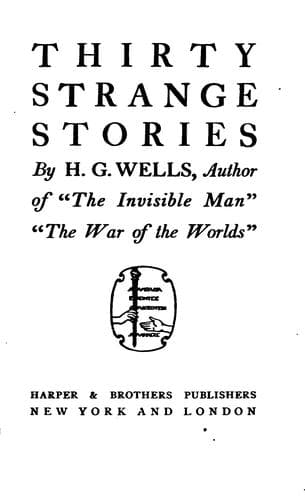
Thirty Strange StoriesWells, H. G. (Herbert George)
Science
Thirty Strange Stories
Wells, H. G. (Herbert George)
Fantasy fiction, English; Science fiction, English; Short stories, English
Then, suddenly, came a sound, like the sound of a tolling bell: faint,
as if infinitely far; muffled, as though heard through thick swathings
of darkness,—a deep vibrating resonance with vast gulfs of silence
between each stroke. And the Hand appeared to tighten on the rod. And I
saw far above the Hand, towards the apex of the darkness, a circle of
dim phosphorescence, a ghostly sphere whence these sounds came
throbbing; and at the last stroke the Hand vanished, for the hour had
come, and I heard a noise of many waters. But the black rod remained as
a great band across the sky. And then a voice, which seemed to run to
the uttermost parts of space, spoke, saying: “There will be no more
pain.”
At that an almost intolerable gladness and radiance rushed in upon me,
and I saw the circle shining white and bright, and the rod black and
shining, and many other things else distinct and clear. And the circle
was the face of the clock, and the rod the rail of my bed. Haddon was
standing at the foot, against the rail, with a small pair of scissors on
his fingers; and the hands of my clock on the mantel over his shoulder
were clasped together over the hour of twelve. Mowbray was washing
something in a basin at the octagonal table, and at my side I felt a
subdued feeling that could scarce be spoken of as pain.
The operation had not killed me. And I perceived suddenly that the dull
melancholy of half a year was lifted from my mind.
THE RECONCILIATION
Temple had scarcely been with Findlay five minutes before he felt his
old resentments, and the memory of that unforgettable wrong growing
vivid again. But with the infatuation of his good resolution still upon
him, he maintained the air of sham reconciliation that Findlay had
welcomed so eagerly. They talked of this and that, carefully avoiding
the matter of the separation. Temple at first spoke chiefly of his
travels. He stood between the cabinet of minerals and the fireplace, his
whiskey on the mantel-board, while Findlay sat with his chair pushed
back from his writing-desk, on which were scattered the dozen little
skulls of hedgehogs and shrew mice upon which he had been working.
Temple’s eye fell upon them, and abruptly brought his mind round from
the topic of West Africa. “And you—” said Temple. “While I have been
wandering I suppose you have been going on steadily.”
“Drumming along,” said Findlay.
“To the Royal Society and fame and all the things we used to dream
about—How long is it?”
“Five years—since our student days.”
Temple glanced round the room, and his eye rested for a moment on a
round greyish-drab object that lay in the corner near the door. “The
same fat books and folios, only more of them, the same smell of old
bones, and a dissection—is it the same one?—in the window. Fame is
_your_ mistress?”
“Fame,” said Findlay. “But it’s hardly fame. The herd outside say,
‘Eminence in comparative anatomy.’”
Public-domain text, read in full here on John Shaqi.
Reviews
Reviews
No reviews yet
Be the first to share your thoughts on this work.
Elsewhere in the archive
Join the Discussion
Join the discussion
Sign in to leave a comment or review.
Sign InorCreate an account