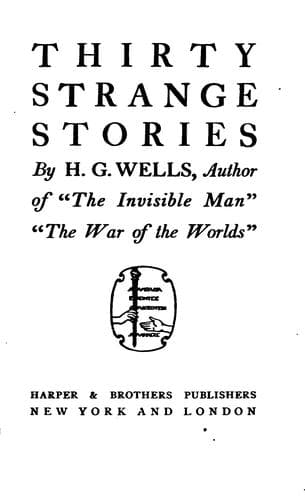
Thirty Strange StoriesWells, H. G. (Herbert George)
Science
Thirty Strange Stories
Wells, H. G. (Herbert George)
Fantasy fiction, English; Science fiction, English; Short stories, English
At first his interest had been divided pretty equally between his
biological work at the College and social and theological theorising, an
employment which he took in deadly earnest. Of a night, when the big
museum library was not open, he would sit on the bed of his room in
Chelsea with his coat and a muffler on, and write out the lecture notes
and revise his dissection memoranda until Thorpe called him out by a
whistle,—the landlady objected to open the door to attic visitors,—and
then the two would go prowling about the shadowy, shiny, gas-lit
streets, talking, very much in the fashion of the sample just given, of
the God Idea and Righteousness and Carlyle and the Reorganisation of
Society. And in the midst of it all, Hill, arguing not only for Thorpe
but for the casual passer-by, would lose the thread of his argument,
glancing at some pretty, painted face that looked meaningly at him as he
passed. Science and Righteousness! But once or twice lately there had
been signs that a third interest was creeping into his life, and he had
found his attention wandering from the fate of the mesoblastic somites
or the probable meaning of the blastopore, to the thought of the girl
with the brown eyes who sat at the table before him.
She was a paying student; she descended inconceivable social altitudes
to speak to him. At the thought of the education she must have had and
the accomplishments she must possess, the soul of Hill became abject
within him. She had spoken to him first over a difficulty about the
alisphenoid of a rabbit’s skull, and he had found that, in biology at
least, he had no reason for self-abasement. And from that, after the
manner of young people starting from any starting-point, they got to
generalities, and while Hill attacked her upon the question of
socialism,—some instinct told him to spare her a direct assault upon her
religion,—she was gathering resolution to undertake what she told
herself was his æsthetic education. She was a year or two older than he,
though the thought never occurred to him. The loan of “News from
Nowhere” was the beginning of a series of cross loans. Upon some absurd
first principle of his, Hill had never “wasted time” upon poetry, and it
seemed an appalling deficiency to her. One day in the lunch hour, when
she chanced upon him alone in the little museum where the skeletons were
arranged, shamefully eating the bun that constituted his midday meal,
she retreated and returned, to lend him, with a slightly furtive air, a
volume of Browning. He stood sideways towards her and took the book
rather clumsily, because he was holding the bun in the other hand. And
in the retrospect his voice lacked the cheerful clearness he could have
wished.
Public-domain text, read in full here on John Shaqi.
Reviews
Reviews
No reviews yet
Be the first to share your thoughts on this work.
Elsewhere in the archive
Join the Discussion
Join the discussion
Sign in to leave a comment or review.
Sign InorCreate an account