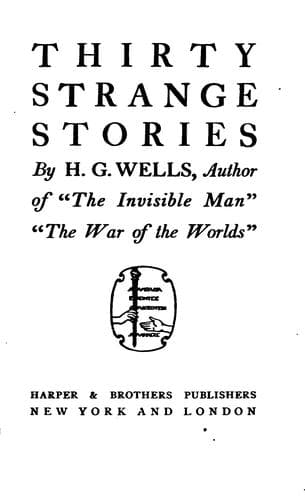
Thirty Strange StoriesWells, H. G. (Herbert George)
Science
Thirty Strange Stories
Wells, H. G. (Herbert George)
Fantasy fiction, English; Science fiction, English; Short stories, English
It was just the kind of thing that the botanical professor was always
doing. Like the income tax, it offered a premium to the cheat. It was a
preparation under the microscope, a little glass slip, held in its place
on the stage of the instrument by light steel clips, and the inscription
set forth that the slip was not to be moved. Each student was to go in
turn to it, sketch it, write in his book of answers what he considered
it to be, and return to his place. Now to move such a slip is a thing
one can do by a chance movement of the finger, and in a fraction of a
second. The professor’s reason for decreeing that the slip should not be
moved depended on the fact that the object he wanted identified was
characteristic of a certain tree stem. In the position in which it was
placed it was a difficult thing to recognise, but once the slip was
moved so as to bring other parts of the preparation into view, its
nature was obvious enough.
Hill came to this, flushed from a contest with staining reagents, sat
down on the little stool before the microscope, turned the mirror to get
the best light, and then out of sheer habit shifted the slip. At once he
remembered the prohibition, and with an almost continuous motion of his
hands, moved it back, and sat paralysed with astonishment at his action.
Then slowly he turned his head. The professor was out of the room, the
demonstrator sat aloft on his impromptu rostrum, reading the “Q. Jour.
Mi. Sci.,” the rest of the examinees were busy and with their backs to
him. Should he own up to the accident now? He knew quite clearly what
the thing was. It was a lenticel, a characteristic preparation from the
elder-tree. His eye roved over his intent fellow-students and Wedderburn
suddenly glanced over his shoulder at him with a queer expression in his
eyes. The mental excitement that had kept Hill at an abnormal pitch of
vigour these two days gave way to a curious nervous tension. His book of
answers was beside him. He did not write down what the thing was, but
with one eye at the microscope he began making a hasty sketch of it. His
mind was full of this grotesque puzzle in ethics that had suddenly been
sprung upon him. Should he identify it? Or should he leave this question
unanswered? In that case Wedderburn would probably come out first in the
botanical list. How could he tell now whether he might not have
identified the thing without shifting it? It was possible that
Wedderburn had failed to recognise it, of course. Suppose Wedderburn,
too, had shifted the slide? He looked up at the clock. There were
fifteen minutes in which to make up his mind. He gathered up his book of
answers and the coloured pencils he used in illustrating his replies,
and walked back to his seat.
Public-domain text, read in full here on John Shaqi.
Reviews
Reviews
No reviews yet
Be the first to share your thoughts on this work.
Elsewhere in the archive
Join the Discussion
Join the discussion
Sign in to leave a comment or review.
Sign InorCreate an account