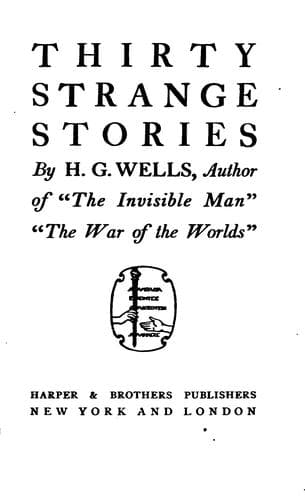
Thirty Strange StoriesWells, H. G. (Herbert George)
Science
Thirty Strange Stories
Wells, H. G. (Herbert George)
Fantasy fiction, English; Science fiction, English; Short stories, English
The lantern flared as Woodhouse entered his circular den, and the
general darkness fled into black shadows behind the big machine, from
which it presently seemed to creep back over the whole place again as
the light waned. The slit was a profound transparent blue, in which six
stars shone with tropical brilliance, and their light lay, a pallid
gleam, along the black tube of the instrument. Woodhouse shifted the
roof, and then proceeding to the telescope, turned first one wheel and
then another, the great cylinder slowly swinging into a new position.
Then he glanced through the finder, the little companion telescope,
moved the roof a little more, made some further adjustments, and set the
clockwork in motion. He took off his jacket, for the night was very hot,
and pushed into position the uncomfortable seat to which he was
condemned for the next four hours. Then with a sigh he resigned himself
to his watch upon the mysteries of space.
There was no sound now in the observatory, and the lantern waned
steadily. Outside there was the occasional cry of some animal in alarm
or pain, or calling to its mate, and the intermittent sounds of the
Malay and Dyak servants. Presently one of the men began a queer chanting
song, in which the others joined at intervals. After this it would seem
that they turned in for the night, for no further sound came from their
direction, and the whispering stillness became more and more profound.
The clockwork ticked steadily. The shrill hum of a mosquito explored the
place and grew shriller in indignation at Woodhouse’s ointment. Then the
lantern went out and all the observatory was black.
Woodhouse shifted his position presently, when the slow movement of the
telescope had carried it beyond the limits of his comfort.
He was watching a little group of stars in the Milky Way, in one of
which his chief had seen or fancied a remarkable colour variability. It
was not a part of the regular work for which the establishment existed,
and for that reason perhaps Woodhouse was deeply interested. He must
have forgotten things terrestrial. All his attention was concentrated
upon the great blue circle of the telescope field—a circle powdered, so
it seemed, with an innumerable multitude of stars, and all luminous
against the blackness of its setting. As he watched he seemed to himself
to become incorporeal, as if he too were floating in the ether of space.
Infinitely remote was the faint red spot he was observing.
Suddenly the stars were blotted out. A flash of blackness passed, and
they were visible again.
“Queer,” said Woodhouse. “Must have been a bird.”
The thing happened again, and immediately after the great tube shivered
as though it had been struck. Then the dome of the observatory resounded
with a series of thundering blows. The stars seemed to sweep aside as
the telescope swung round and away from the slit in the roof.
“Great Scott!” cried Woodhouse. “What’s this?”
Public-domain text, read in full here on John Shaqi.
Reviews
Reviews
No reviews yet
Be the first to share your thoughts on this work.
Elsewhere in the archive
Join the Discussion
Join the discussion
Sign in to leave a comment or review.
Sign InorCreate an account