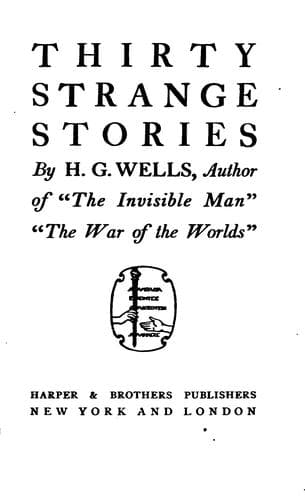
Thirty Strange StoriesWells, H. G. (Herbert George)
Science
Thirty Strange Stories
Wells, H. G. (Herbert George)
Fantasy fiction, English; Science fiction, English; Short stories, English
One hopeful line was to anticipate a sudden afflux of customers.
“Perhaps,” said Minnie, “you might get together fifty. They know you
well enough to trust you a bit.” They debated that point. Once the
possibility of Helter, Skelter, & Grab giving credit was admitted, it
was pleasant to begin sweating the acceptable minimum. For some half
hour over tea the second day after Winslow’s discoveries they were quite
cheerful again, laughing even at their terrific fears. Even twenty
pounds, to go on with, might be considered enough. Then in some
mysterious way the pleasant prospect of Messrs. Helter, Skelter, & Grab
tempering the wind to the shorn retailer vanished—vanished absolutely,
and Winslow found himself again in the pit of despair.
He began looking about at the furniture, and wondering idly what it
would fetch. The chiffonier was good, anyhow, and there were Minnie’s
old plates that her mother used to have. Then he began to think of
desperate expedients for putting off the evil day. He had heard
somewhere of Bills of Sale—there was to his ears something comfortingly
substantial in the phrase. Then why not “Go to the Money Lenders?”
One cheering thing happened on Thursday afternoon; a little girl came in
with a pattern of “print” and he was able to match it. He had not been
able to match anything out of his meagre stock before. He went in and
told Minnie. The incident is mentioned lest the reader should imagine it
was uniform despair with him.
The next morning, and the next, after the discovery, Winslow opened shop
late. When one has been awake most of the night, and has no hope, what
_is_ the good of getting up punctually? But as he went into the dark
shop on Friday a strange event happened. He saw something lying on the
floor, something lit by the bright light that came under the ill-fitting
door—a black oblong. He stooped and picked up an envelope with a deep
mourning edge. It was addressed to his wife. Clearly a death in her
family—perhaps her uncle. He knew the man too well to have expectations.
And they would have to get mourning and go to the funeral. The brutal
cruelty of people dying! He saw it all in a flash—he always visualised
his thoughts. Black trousers to get, black crape, black gloves,—none in
stock,—the railway fares, the shop closed for the day.
“I’m afraid there’s bad news, Minnie,” he said.
She was kneeling before the fireplace, blowing the fire. She had her
housemaid’s gloves on and the old country sun-bonnet she wore of a
morning, to keep the dust out of her hair. She turned, saw the envelope,
gave a gasp, and pressed two bloodless lips together.
“I’m afraid it’s uncle,” she said, holding the letter and staring with
eyes wide open into Winslow’s face. “_It’s a strange hand!_”
“The postmark’s Hull,” said Winslow.
“The postmark’s Hull.”
Minnie opened the letter slowly, drew it out, hesitated, turned it over,
saw the signature. “It’s Mr. Speight!”
“What does he say?” said Winslow.
Public-domain text, read in full here on John Shaqi.
Reviews
Reviews
No reviews yet
Be the first to share your thoughts on this work.
Elsewhere in the archive
Join the Discussion
Join the discussion
Sign in to leave a comment or review.
Sign InorCreate an account