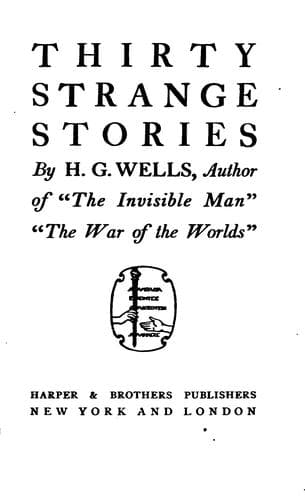
Thirty Strange StoriesWells, H. G. (Herbert George)
Science
Thirty Strange Stories
Wells, H. G. (Herbert George)
Fantasy fiction, English; Science fiction, English; Short stories, English
It was certainly a strange-looking globe, not really an apple, Mr.
Hinchcliff saw, and a curious glowing golden colour, almost as though
light itself was wrought into its substance. As he looked at it, he
began to see more vividly the desolate valley among the mountains, the
guarding swords of fire, the strange antiquities of the story he had
just heard. He rubbed a knuckle into his eye. “But—” said he.
“It has kept like that, smooth and full, three months. Longer than that
it is now by some days. No drying, no withering, no decay.”
“And you yourself,” said Mr. Hinchcliff, “really believe that—”
“Is the Forbidden Fruit.”
There was no mistaking the earnestness of the man’s manner and his
perfect sanity. “The Fruit of Knowledge,” he said.
“Suppose it was?” said Mr. Hinchcliff, after a pause, still staring at
it. “But after all,” said Mr. Hinchcliff, “it’s not my kind of
knowledge—not the sort of knowledge. I mean, Adam and Eve have eaten it
already.”
“We inherit their sins—not their knowledge,” said the stranger. “That
would make it all clear and bright again. We should see into everything,
through everything, into the deepest meaning of everything—”
“Why don’t you eat it, then?” said Mr. Hinchcliff, with an inspiration.
“I took it intending to eat it,” said the stranger. “Man has fallen.
Merely to eat again could scarcely—”
“Knowledge is power,” said Mr. Hinchcliff.
“But is it happiness? I am older than you—more than twice as old. Time
after time I have held this in my hand, and my heart has failed me at
the thought of all that one might know, that terrible lucidity—Suppose
suddenly all the world became pitilessly clear?”
“That, I think, would be a great advantage,” said Mr. Hinchcliff, “on
the whole.”
“Suppose you saw into the hearts and minds of every one about you, into
their most secret recesses—people you loved, whose love you valued?”
“You’d soon find out the humbugs,” said Mr. Hinchcliff, greatly struck
by the idea.
“And worse—to know yourself, bare of your most intimate illusions. To
see yourself in your place. All that your lusts and weaknesses prevented
your doing. No merciful perspective.”
“That might be an excellent thing too. ‘Know thyself,’ you know.”
“You are young,” said the stranger.
“If you don’t care to eat it, and it bothers you, why don’t you throw it
away?”
“There again, perhaps, you will not understand me. To me, how could one
throw away a thing like that, glowing, wonderful? Once one has it, one
is bound. But, on the other hand, to _give_ it away! To give it away to
some one who thirsted after knowledge, who found no terror in the
thought of that clear perception—”
“Of course,” said Mr. Hinchcliff, thoughtfully, “it might be some sort
of poisonous fruit.”
Public-domain text, read in full here on John Shaqi.
Reviews
Reviews
No reviews yet
Be the first to share your thoughts on this work.
Elsewhere in the archive
Join the Discussion
Join the discussion
Sign in to leave a comment or review.
Sign InorCreate an account