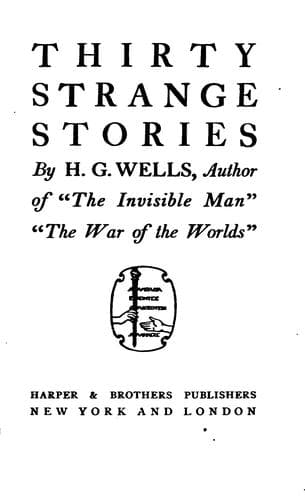
Thirty Strange StoriesWells, H. G. (Herbert George)
Science
Thirty Strange Stories
Wells, H. G. (Herbert George)
Fantasy fiction, English; Science fiction, English; Short stories, English
“Mr. Piddingquirk—William that _was_, ma’am—had white gloves, and a coat
like a clergyman, and a lovely chrysanthemum. He looked so nice, ma’am.
And there was red carpet down, just like for gentlefolks. And they say
he gave the clerk four shillings, ma’am. It was a real kerridge they
had—not a fly. When they came out of church, there was rice-throwing,
and her two little sisters dropping dead flowers. And some one threw a
slipper, and then I threw a boot—”
“Threw a _boot_, Jane!”
“Yes, ma’am. Aimed at _her_. But it hit _him_. Yes, ma’am, hard. Gev him
a black eye, I should think. I only threw that one. I hadn’t the heart
to try again. All the little boys cheered when it hit him.”
After an interval—“I am sorry the boot hit _him_.”
Another pause. The potatoes were being scrubbed violently. “He always
_was_ a bit above me, you know, ma’am. And he was led away.”
The potatoes were more than finished. Jane rose sharply, with a sigh,
and rapped the basin down on the table.
“I don’t care,” she said. “I don’t care a rap. He will find out his
mistake yet. It serves me right. I was stuck up about him. I ought not
to have looked so high. And I am glad things are as things are.”
My wife was in the kitchen, seeing to the higher cookery. After the
confession of the boot-throwing, she must have watched poor Jane fuming
with a certain dismay in those brown eyes of hers. But I imagine they
softened again very quickly, and then Jane’s must have met them.
“Oh, ma’am,” said Jane, with an astonishing change of note, “think of
all that _might_ have been! Oh, ma’am, I _could_ have been so happy! I
ought to have known, but I didn’t know—You’re very kind to let me talk
to you, ma’am—for it’s hard on me, ma’am—it’s har-r-r-r-d—”
And I gather that Euphemia so far forgot herself as to let Jane sob out
some of the fulness of her heart on a sympathetic shoulder. My Euphemia,
thank Heaven, has never properly grasped the importance of “keeping up
her position.” And since that fit of weeping, much of the accent of
bitterness has gone out of Jane’s scrubbing and brush-work.
Indeed, something passed the other day with the butcher-boy—but that
scarcely belongs to this story. However, Jane is young still, and time
and change are at work with her. We all have our sorrows, but I do not
believe very much in the existence of sorrows that never heal.
THE LOST INHERITANCE
“My uncle,” said the man with the glass eye, “was what you might call a
hemi-semi-demi millionaire. He was worth about a hundred and twenty
thousand. Quite. And he left me all his money.”
I glanced at the shiny sleeve of his coat, and my eye travelled up to
the frayed collar.
“Every penny,” said the man with the glass eye, and I caught the active
pupil looking at me with a touch of offence.
“I’ve never had any windfalls like that,” I said, trying to speak
enviously and propitiate him.
Public-domain text, read in full here on John Shaqi.
Reviews
Reviews
No reviews yet
Be the first to share your thoughts on this work.
Elsewhere in the archive
Join the Discussion
Join the discussion
Sign in to leave a comment or review.
Sign InorCreate an account