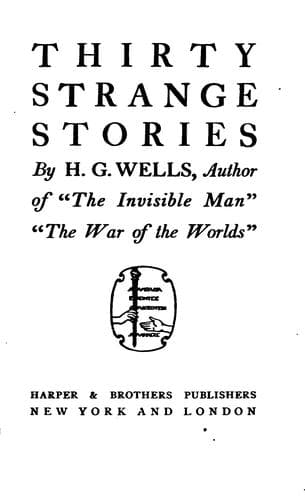
Thirty Strange StoriesWells, H. G. (Herbert George)
Science
Thirty Strange Stories
Wells, H. G. (Herbert George)
Fantasy fiction, English; Science fiction, English; Short stories, English
His eye fell on the sealed case in which Waterhouse had put the
featherless poisoned arrows they had bought in the Mendi country. “I
wish I had hit the beggar somewhere vital,” said Pollock, viciously.
Waterhouse came back after a long interval. He was not communicative,
though Pollock asked him questions enough. The Porroh man, it seems, was
a prominent member of that mystical society. The village was interested,
but not threatening. No doubt the witch-doctor had gone into the bush.
He was a great witch-doctor. “Of course, he’s up to something,” said
Waterhouse, and became silent.
“But what can he do?” asked Pollock, unheeded.
“I must get you out of this. There’s something brewing, or things would
not be so quiet,” said Waterhouse, after a gap of silence. Pollock
wanted to know what the brew might be. “Dancing in a circle of skulls,”
said Waterhouse; “brewing a stink in a copper pot.” Pollock wanted
particulars. Waterhouse was vague, Pollock pressing. At last Waterhouse
lost his temper. “How the devil should _I_ know?” he said to Pollock’s
twentieth inquiry what the Porroh man would do. “He tried to kill you
off-hand in the hut. _Now_, I fancy he will try something more
elaborate. But you’ll see fast enough. I don’t want to help unnerve you.
It’s probably all nonsense.”
That night, as they were sitting at their fire, Pollock again tried to
draw Waterhouse out on the subject of Porroh methods. “Better get to
sleep,” said Waterhouse, when Pollock’s bent became apparent; “we start
early to-morrow. You may want all your nerve about you.”
“But what line will he take?”
“Can’t say. They’re versatile people. They know a lot of rum dodges.
You’d better get that copper-devil, Shakespear, to talk.”
There was a flash and a heavy bang out of the darkness behind the huts,
and a clay bullet came whistling close to Pollock’s head. This, at
least, was crude enough. The blacks and half-breeds sitting and yarning
round their own fire jumped up, and some one fired into the dark.
“Better go into one of the huts,” said Waterhouse, quietly, still
sitting unmoved.
Pollock stood up by the fire and drew his revolver. Fighting, at least,
he was not afraid of. But a man in the dark is in the best of armour.
Realising the wisdom of Waterhouse’s advice, Pollock went into the tent
and lay down there.
What little sleep he had was disturbed by dreams, variegated dreams, but
chiefly of the Porroh man’s face, upside down, as he went out of the
hut, and looked up under his arm. It was odd that this transitory
impression should have stuck so firmly in Pollock’s memory. Moreover, he
was troubled by queer pains in his limbs.
In the white haze of the early morning, as they were loading the canoes,
a barbed arrow suddenly appeared quivering in the ground close to
Pollock’s foot. The boys made a perfunctory effort to clear out the
thicket, but it led to no capture.
Public-domain text, read in full here on John Shaqi.
Reviews
Reviews
No reviews yet
Be the first to share your thoughts on this work.
Elsewhere in the archive
Join the Discussion
Join the discussion
Sign in to leave a comment or review.
Sign InorCreate an account