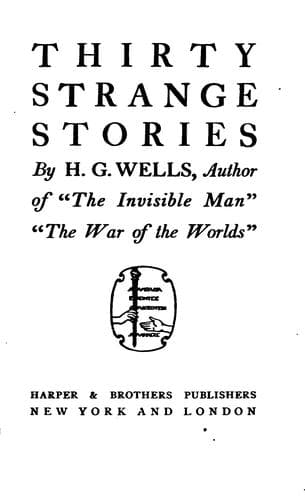
Thirty Strange StoriesWells, H. G. (Herbert George)
Science
Thirty Strange Stories
Wells, H. G. (Herbert George)
Fantasy fiction, English; Science fiction, English; Short stories, English
And now to tell what is perhaps the most astonishing fact in this whole
astonishing raid. We have not the slightest knowledge of the subsequent
movements of the shoal, although the whole southwest coast was now alert
for it. But it may, perhaps, be significant that a cachalot was stranded
off Sark on June 3. Two weeks and three days after this Sidmouth affair,
a living _Haploteuthis_ came ashore on Calais sands. It was alive,
because several witnesses saw its tentacles moving in a convulsive way.
But it is probable that it was dying. A gentleman named Pouchet obtained
a rifle and shot it.
That was the last appearance of a living _Haploteuthis_. No others were
seen on the French coast. On the 15th of June a dead body, almost
complete, was washed ashore near Torquay, and a few days later a boat
from the Marine Biological station, engaged in dredging off Plymouth,
picked up a rotting specimen, slashed deeply with a cutlass wound. How
the former specimen had come by its death it is impossible to say. And
on the last day of June, Mr. Egbert Caine, an artist, bathing near
Newlyn, threw up his arms, shrieked, and was drawn under. A friend
bathing with him made no attempt to save him, but swam at once for the
shore. This is the last fact to tell of this extraordinary raid from the
deeper sea. Whether it is really the last of these horrible creatures it
is, as yet, premature to say. But it is believed, and certainly it is to
be hoped, that they have returned now, and returned for good, to the
sunless depths of the middle seas, out of which they have so strangely
and so mysteriously arisen.
IN THE MODERN VEIN
AN UNSYMPATHETIC LOVE STORY
Of course the cultivated reader has heard of Aubrey Vair. He has
published on three several occasions volumes of delicate verses,—some,
indeed, border on indelicacy,—and his column “Of Things Literary” in the
“Climax” is well known. His Byronic visage and an interview have
appeared in the “Perfect Lady.” It was Aubrey Vair, I believe, who
demonstrated that the humour of Dickens was worse than his sentiment,
and who detected “a subtle bourgeois flavour” in Shakespeare. However,
it is not generally known that Aubrey Vair has had erotic experiences as
well as erotic inspirations. He adopted Goethe some little time since as
his literary prototype, and that may have had something to do with his
temporary lapse from sexual integrity.
Public-domain text, read in full here on John Shaqi.
Reviews
Reviews
No reviews yet
Be the first to share your thoughts on this work.
Elsewhere in the archive
Join the Discussion
Join the discussion
Sign in to leave a comment or review.
Sign InorCreate an account