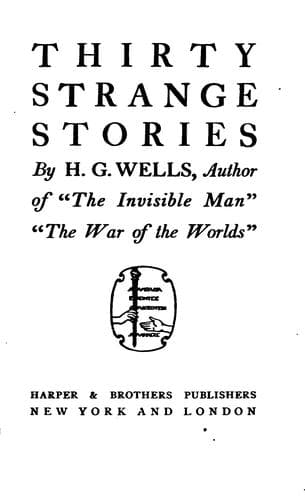
Thirty Strange StoriesWells, H. G. (Herbert George)
Science
Thirty Strange Stories
Wells, H. G. (Herbert George)
Fantasy fiction, English; Science fiction, English; Short stories, English
“What if I die under it!” The thought recurred again and again as I
walked home from Haddon’s. It was a purely personal question. I was
spared the deep anxieties of a married man, and I knew there were few of
my intimate friends but would find my death troublesome chiefly on
account of the duty of regret. I was surprised indeed, and perhaps a
little humiliated, as I turned the matter over, to think how few could
possibly exceed the conventional requirement. Things came before me
stripped of glamour, in a clear dry light, during that walk from
Haddon’s house over Primrose Hill. There were the friends of my youth: I
perceived now that our affection was a tradition, which we foregathered
rather laboriously to maintain. There were the rivals and helpers of my
later career. I suppose I had been cold-blooded or undemonstrative—one
perhaps implies the other. It may be that even the capacity for
friendship is a question of physique. There had been a time in my own
life when I had grieved bitterly enough at the loss of a friend; but as
I walked home that afternoon the emotional side of my imagination was
dormant. I could not pity myself, nor feel sorry for my friends, nor
conceive of them as grieving for me.
I was interested in this deadness of my emotional nature,—no doubt a
concomitant of my stagnating physiology; and my thoughts wandered off
along the line it suggested. Once before, in my hot youth, I had
suffered a sudden loss of blood, and had been within an ace of death. I
remembered now that my affections as well as my passions had drained out
of me, leaving scarce anything but a tranquil resignation and the
faintest dreg of self-pity. It had been weeks before the old ambitions,
and tendernesses, and all the complex moral interplay of a man had
reasserted themselves. It occurred to me that the real meaning of this
numbness might be a gradual slipping away from the pleasure-pain
guidance of the animal man. It has been proven, I take it, as thoroughly
as anything can be proven in this world, that the higher emotions, the
moral feelings, even the subtle tenderness of love, are evolved from the
elemental desires and fears of the simple animal: they are the harness
in which man’s mental freedom goes. And, it may be that, as death
overshadows us, as our possibility of acting diminishes, this complex
growth of balanced impulse, propensity, and aversion, whose interplay
inspires our acts, goes with it. Leaving what?
Public-domain text, read in full here on John Shaqi.
Reviews
Reviews
No reviews yet
Be the first to share your thoughts on this work.
Elsewhere in the archive
Join the Discussion
Join the discussion
Sign in to leave a comment or review.
Sign InorCreate an account