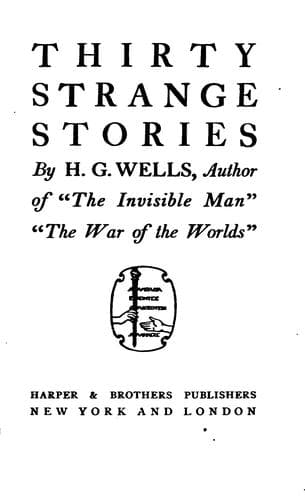
Thirty Strange StoriesWells, H. G. (Herbert George)
Science
Thirty Strange Stories
Wells, H. G. (Herbert George)
Fantasy fiction, English; Science fiction, English; Short stories, English
They stretched me out, with a convenient exposure of my side, and,
almost before I realised what was happening, the chloroform was being
administered. It stings the nostrils and there is a suffocating
sensation, at first. I knew I should die,—that this was the end of
consciousness for me. And suddenly I felt that I was not prepared for
death; I had a vague sense of a duty overlooked—I knew not what. What
was it I had not done? I could think of nothing more to do, nothing
desirable left in life; and yet I had the strangest disinclination to
death. And the physical sensation was painfully oppressive. Of course
the doctors did not know they were going to kill me. Possibly I
struggled. Then I fell motionless, and a great silence, a monstrous
silence, and an impenetrable blackness, came upon me.
There must have been an interval of absolute unconsciousness, seconds or
minutes. Then, with a chilly, unemotional clearness, I perceived that I
was not yet dead. I was still in my body; but all the multitudinous
sensations that come sweeping from it to make up the background of
consciousness, had gone, leaving me free of it all. No, not free of it
all; for as yet something still held me to the poor stark flesh upon the
bed, held me, yet not so closely that I did not feel myself external to
it, independent of it, straining away from it. I do not think I saw, I
do not think I heard; but I perceived all that was going on, and it was
as if I both heard and saw. Haddon was bending over me, Mowbray behind
me; the scalpel—it was a large scalpel—was cutting my flesh at the side
under the flying ribs. It was interesting to see myself cut like cheese,
without a pang, without even a qualm. The interest was much of a quality
with that one might feel in a game of chess between strangers. Haddon’s
face was firm, and his hand steady; but I was surprised to perceive
(_how_ I know now) that he was feeling the gravest doubt as to his own
wisdom in the conduct of the operation.
Mowbray’s thoughts, too, I could see. He was thinking that Haddon’s
manner showed too much of the specialist. New suggestions came up like
bubbles through a stream of frothing meditation, and burst one after
another in the little bright spot of his consciousness. He could not
help noticing and admiring Haddon’s swift dexterity, in spite of his
envious quality and his disposition to detract. I saw my liver exposed.
I was puzzled at my own condition. I did not feel that I was dead, but I
was different in some way from my living self. The grey depression that
had weighed on me for a year or more, and coloured all my thoughts, was
gone. I perceived and thought without any emotional tint at all. I
wondered if every one perceived things in this way under chloroform, and
forgot it again when he came out of it. It would be inconvenient to look
into some heads, and not forget.
Public-domain text, read in full here on John Shaqi.
Reviews
Reviews
No reviews yet
Be the first to share your thoughts on this work.
Elsewhere in the archive
Join the Discussion
Join the discussion
Sign in to leave a comment or review.
Sign InorCreate an account