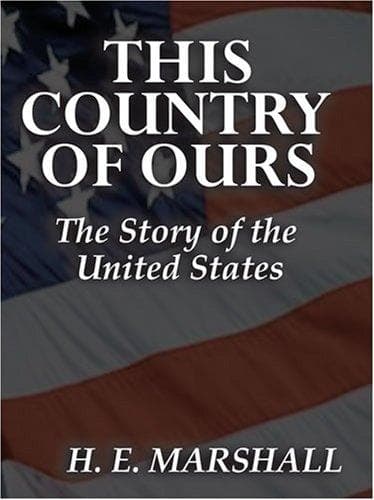
This Country of OursMarshall, H. E. (Henrietta Elizabeth)
History
This Country of Ours
Marshall, H. E. (Henrietta Elizabeth)
United States -- History
Over the Province of Maine, Sir Ferdinando ruled supreme. He could
raise troops, make war, give people titles, levy taxes. No one
might settle down or trade in his province without his permission,
and all must look upon him as the lord of the soil and pay him
tribute. It was the feudal system come again, and Sir Ferdinando
Gorges was as near being a king as any ruler of America ever has
been. He drew up a most elaborate constitution, too, for his kingdom,
making almost more offices than there were citizens to fill them.
For, after all, his kingdom was a mere wilderness containing two
fishing villages and here and there a few scattered settlements.
And when the deputy governor arrived to rule this kingdom he found
his "palace" merely a broken-down store house with "nothing of
household stuff remaining but an old pot, a pair of tongs and a
couple of irons."
Thus side by side with the Puritan colonies of New England,
colonies which were almost republics, there was planted a feudal
state which was almost a monarchy. Of all the New England colonies,
New Hampshire and Maine were the only two which were not founded
for the sake of religion. For although the English Church was
established in both as the state religion that was merely because
the proprietors were of that Church. The colonies were founded for
the sake of trade and profit. But they grew very slowly.
In 1647 Sir Ferdinando Gorges died, and Maine was left much to
itself. For his son John took little interest in his father's great
estate. Thirty years later his grandson, another Ferdinando, sold
his rights to Massachusetts. From that time till 1820, when it
was admitted to the Union as a separate state, Maine was a part of
Massachusetts.
Neither did the heirs of Mason pay much attention to their estates
at first. And when they did there was a good deal of quarrelling
and a good deal of trouble, and at length they sold their rights
to twelve men, who were afterwards known as the Masonian Proprietors.
There was a great deal of trouble, too, before New Hampshire was
finally recognised as a separate colony. It was joined to Massachusetts
and separated again more than once. But at last, after many changes,
New Hampshire finally became a recognised separate colony. And
although Captain John Mason died long before this happened he has
been called the founder of New Hampshire.
"If the highest moral honour," it has been said, "belongs to founders
of states, as Bacon has declared, then Mason deserved it. To seize
on a tract of the American wilderness, to define its limits, to give
it a name, to plant it with an English colony, and to die giving
it his last thoughts among worldly concerns, are acts as lofty and
noble as any recorded in the history of colonisation."
__________
Chapter 29 - The Founding of Connecticut and War with the Indians
Public-domain text, read in full here on John Shaqi.
Reviews
Reviews
No reviews yet
Be the first to share your thoughts on this work.
Elsewhere in the archive
Join the Discussion
Join the discussion
Sign in to leave a comment or review.
Sign InorCreate an account