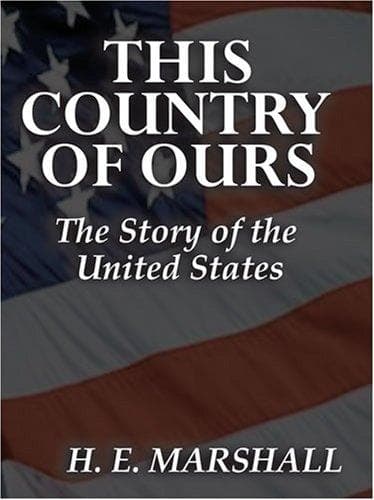
This Country of OursMarshall, H. E. (Henrietta Elizabeth)
History
This Country of Ours
Marshall, H. E. (Henrietta Elizabeth)
United States -- History
The minister in whose house the persecution began was punished. For
the people were so angry with him and the part he had taken that
they would have no more to do with him, and he was obliged to leave
Salem village.
Some others who had taken as great a part as he in hounding guiltless
people to death remained impenitent and unpunished. But the jury
and some of the judges made some amends. They did a hard thing,
for they publicly acknowledged that they had been wrong. The jury
wrote and signed a paper in which they said, "We do hereby declare
that we justly fear that we were sadly deluded and mistaken, for
which we are much disquieted and distressed in our minds. And do
therefore humbly beg forgiveness."
One of the judges, Judge Sewall, was bitterly grieved at the part
he had played. And on a day of general intercession he stood up
before the whole congregation, acknowledging his guilt and praying
God to forgive him. And throughout all his life he kept one day a
year upon which he prayed and fasted in repentance.
Perhaps you may think that there is nothing in this story to make
you proud of your ancestors. But think again. Think of the courage
of those men and women who cheerfully went to death rather than
save their lives by lying and making false confessions. Truth to
those brave men and women was worth more than life. And is there
nothing to be proud of in the fact that the judge and jury, when
they found themselves in the wrong, had the manliness to own it
publicly and without reserve?
To some of us nothing in all the world seems so hard as to own
ourselves in the wrong.
Part IV STORIES OF THE MIDDLE AND SOUTHERN COLONIES
__________
Chapter 35 - The Founding of Maryland
About the same time as Gorges was making laws for his little kingdom
of New Hampshire another English gentleman was doing much the same
somewhat farther south. This was Lord Baltimore.
The first Lord Baltimore was a Yorkshire gentleman named Calvert;
he was a favourite of James I, who made him a baron, and he took
his title from a tiny village in Ireland.
Like so many other men of his time Lord Baltimore was interested
in America, and wanted to found a colony there. First he tried to
found one in Newfoundland. There he received a large grant of land
which he called Avalon after the fabled land in the story of King
Arthur, and he had a kind of fairy vision of the warmth and sunny
delights which were to be found in his new land.
But instead of being warm and sunny he found that Newfoundland was
bleak and cold, so his fairy vision shriveled and died, and be came
home and asked for a grant of land on the Potomac instead. In 1632
King James gave Lord Baltimore what he asked and called the land
Maryland in honour of his wife, Queen Henrietta Maria.
Public-domain text, read in full here on John Shaqi.
Reviews
Reviews
No reviews yet
Be the first to share your thoughts on this work.
Elsewhere in the archive
Join the Discussion
Join the discussion
Sign in to leave a comment or review.
Sign InorCreate an account