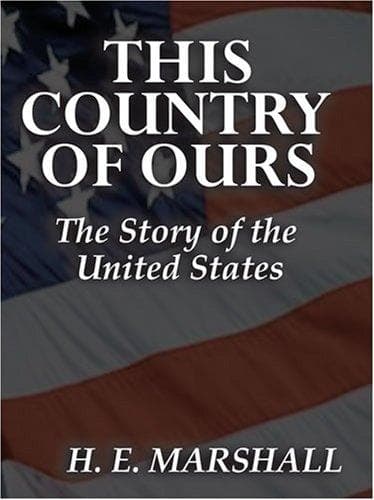
This Country of OursMarshall, H. E. (Henrietta Elizabeth)
History
This Country of Ours
Marshall, H. E. (Henrietta Elizabeth)
United States -- History
Shouting "God save the King" the British returned to fire. But it
availed little, for they could not see the enemy. From the shelter
of the forest, hidden behind trees, the French and Indians fired
upon the British. They were an easy mark, for they stood solidly,
shoulder to shoulder, their scarlet coats showing clearly against
the green background. Still the British stood their ground firing
volley after volley. It was quite useless, for they could see no
enemy. The puffs of smoke were their only guides. To aim at the
points where the smoke came from was all they could do. But for
the most part their bullets crashed through the branches, or were
buried in tree trunks, while the pitiless rain of lead mowed down
the redcoats.
The American soldiers fared better. For as soon as they were attacked
they scattered, and from behind the shelter of trees fought the
Indians in their own fashion. Some of the British tried to do the
same. But Braddock had no knowledge of savage warfare. To fight in
such a manner seemed to him shocking. It was unsoldierly; it was
cowardly. So he swore savagely at his men, calling them cowards,
and beat them back into line with the flat of his sword. And thus
huddled together they stood a brilliant, living target for the
bullets of the savages.
Braddock himself fought with fury. He dashed here and there, swearing,
commanding, threatening. Four horses were shot under him, and at
last he himself fell wounded to death.
Washington too fought with fearless bravery, trying to carry out
Braddock's frenzied orders. And although he escaped unhurt his
clothes were riddled with holes, and twice his horse was shot under
him.
For nearly three hours the terrible carnage lasted. Then flesh
and blood could stand no more, and the men broke rank and fled.
All night they fled in utter rout, bearing with them their wounded
leader.
At length they reached Dunbar's camp. But even them they did not
pause. For the news of the disaster had thrown the whole camp into
confusion. Frantic orders were given, and obeyed with frenzied
haste. Wagon loads of stores were burned, barrels of gunpowder
were staved in, and the contents poured into the river; shells and
bullets were buried. The, the work of destruction complete, the
whole army moved on again in utter rout.
And now Braddock's dark, last hour had come. Brooding and silent
he lay in his litter. This awful defeat was something he could not
grasp. "Who would have thought it?" he murmured. "Who would have
thought it?" But his stubborn spirit was yet unbroken. "We will
know better how to do it another time," he sighed. A few minutes
later he died.
His men buried him in the middle of the road, Washington reading
over him the prayers for the dead. Then lest the Indians should
find and desecrate his last resting-place the whole army passed
over his grave.
__________
Chapter 49 - The End of the French Rule in America
Public-domain text, read in full here on John Shaqi.
Reviews
Reviews
No reviews yet
Be the first to share your thoughts on this work.
Elsewhere in the archive
Join the Discussion
Join the discussion
Sign in to leave a comment or review.
Sign InorCreate an account