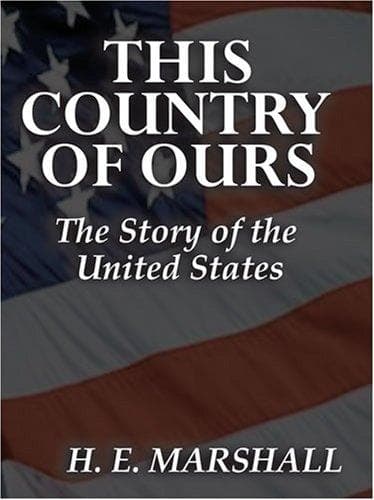
This Country of OursMarshall, H. E. (Henrietta Elizabeth)
History
This Country of Ours
Marshall, H. E. (Henrietta Elizabeth)
United States -- History
Meetings, too, were held throughout the country, when patriots
urged the need of arming and fighting. In the Virginian Convention,
Patrick Henry, the great orator, thrilled his hearers with his
fiery eloquence. "We must fight," he cried, "I repeat it, we must
fight! An appeal to arms and to the God of Hosts is all that is
left us." Brilliantly, convincingly he spoke, and ended with the
unforgettable words:-- "Is life so dear, or peace so sweet as to be
purchased at the price of chains and slavery! Forbid it, Almighty
God! I know not what course others may take, but as for me, give
me liberty or give me death!"
"His last exclamation," said one who heard him, "was like the shout
of the leader who turns back the rout of battle."
But even yet the leaders of the country hoped to avoid a war. The
second Continental Congress met at Philadelphia on the 10th of
May and the members talked anxiously of ways and means to restore
peace. But it was already too late. For the gathered army was no
longer to be restrained, and the very day upon which Congress met
a British fortress had been seized by the colonists.
The chain of lakes and rivers connecting the Hudson with the St.
Lawrence was felt to be of great importance to the colonists. For
if Britain had control of it it would cut the colonies in two, and
stop intercourse between New England and the south. It would also
give the British an easy route by which to bring troops and supplies
from Canada.
Among those who felt the importance of this route was Benedict Arnold,
and the day after he arrived at Cambridge he laid his ideas before
the Massachusetts Committee of Safety, and asked to be allowed to
attack the forts guarding this waterway. His request was granted.
He was given the rank of colonel, and authority to raise a company
of four hundred men for the purpose.
Arnold set out at once, but he soon found that he was not first in
the field. For the people of Connecticut, too, had felt the value
of this waterway and Ethan Allen with a hundred and fifty volunteers
who went by the name of Green Mountain Boys had set out for the
same purpose. These Green Mountain Boys took their name from the
district of Vermont which means Green Mountain. That district,
under the name of New Hampshire Grants, had been claimed by New
York colony. But the Green Mountain Boys had resisted the claim,
and by force of arms proved their right to be considered a separate
colony. Thus having settled their own little revolution they were
now ready to take part in the great one.
At Castleton, Vermont, Arnold met Ethan Allen and his men, and
claimed the leadership of the expedition. But the Green Mountain
Boys scouted the idea. They would fight under their own leader or
not fight at all, they said, and as Arnold had gathered very few
of his four hundred men he had to give way. So instead of leading
the expedition he joined it as a volunteer.
Public-domain text, read in full here on John Shaqi.
Reviews
Reviews
No reviews yet
Be the first to share your thoughts on this work.
Elsewhere in the archive
Join the Discussion
Join the discussion
Sign in to leave a comment or review.
Sign InorCreate an account