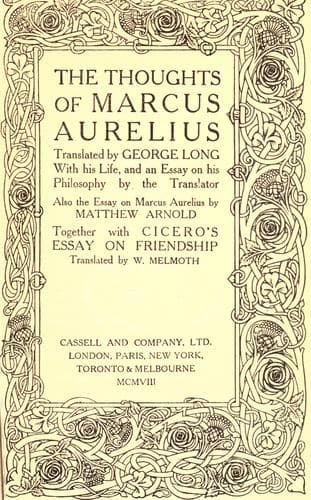
Thoughts of Marcus AureliusMarcus Aurelius, Emperor of Rome
PhilosophyPhilosophy
Thoughts of Marcus Aurelius
Marcus Aurelius, Emperor of Rome
Ethics; Life; Marcus Aurelius, Emperor of Rome, 121-180; Stoics
36. Man, thou hast been a citizen in this great state [the world]; what
difference does it make to thee whether for five years [or three]? for
that which is conformable to the laws is just for all. Where is the
hardship then, if no tyrant nor yet an unjust judge sends thee away
from the state, but nature, who brought thee into it? the same as if a
praetor who has employed an actor dismisses him from the stage.—“But I
have not finished the five acts, but only three of them.”—Thou sayest
well, but in life the three acts are the whole drama; for what shall be
a complete drama is determined by him who was once the cause of its
composition, and now of its dissolution: but thou art the cause of
neither. Depart then satisfied, for he also who releases thee is
satisfied.
THE PHILOSOPHY OF MARCUS AURELIUS ANTONINUS.
It has been said that the Stoic philosophy first showed its real value
when it passed from Greece to Rome. The doctrines of Zeno and his
successors were well suited to the gravity and practical good sense of
the Romans; and even in the Republican period we have an example of a
man, M. Cato Uticensis, who lived the life of a Stoic and died
consistently with the opinions which he professed. He was a man, says
Cicero, who embraced the Stoic philosophy from conviction; not for the
purpose of vain discussion, as most did, but in order to make his life
conformable to the Stoic precepts. In the wretched times from the death
of Augustus to the murder of Domitian, there was nothing but the Stoic
philosophy which could console and support the followers of the old
religion under imperial tyranny and amidst universal corruption. There
were even then noble minds that could dare and endure, sustained by a
good conscience and an elevated idea of the purposes of man’s
existence. Such were Paetus Thrasca, Helvidius Priscus, Cornutus, C.
Musonius Rufus, and the poets Persius and Juvenal, whose energetic
language and manly thoughts may be as instructive to us now as they
might have been to their contemporaries. Persius died under Nero’s
bloody reign; but Juvenal had the good fortune to survive the tyrant
Domitian and to see the better times of Nerva, Trajan, and Hadrian. His
best precepts are derived from the Stoic school, and they are enforced
in his finest verses by the unrivalled vigor of the Latin language.
Public-domain text, read in full here on John Shaqi.
Reviews
Reviews
No reviews yet
Be the first to share your thoughts on this work.
Elsewhere in the archive
Join the Discussion
Join the discussion
Sign in to leave a comment or review.
Sign InorCreate an account