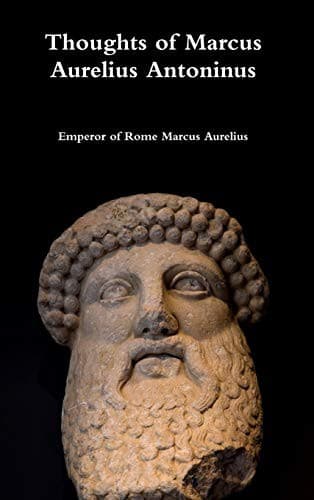
Thoughts of Marcus Aurelius AntoninusMarcus Aurelius, Emperor of Rome
PhilosophyPhilosophy
Thoughts of Marcus Aurelius Antoninus
Marcus Aurelius, Emperor of Rome
Ethics; Life; Marcus Aurelius, Emperor of Rome, 121-180; Stoics
[A] Plato, Gorgias, c. 68 (512). In this passage the text of
Antoninus has [Greek: eateon], which is perhaps right; but
there is a difficulty in the words [Greek: mê gar touto men,
to zên hoposondê chronon tonge hôs alêthos andra eateon esti, kai
ou] &C. The conjecture [Greek: eukteon] for [Greek: eateon]
does not mend the matter.
[B] It is said that this is not in the extant writings of
Plato.
49. Consider the past,--such great changes of political supremacies;
thou mayest foresee also the things which will be. For they will
certainly be of like form, and it is not possible that they should
deviate from the order of the things which take place now; accordingly
to have contemplated human life for forty years is the same as to have
contemplated it for ten thousand years. For what more wilt thou see?
50. That which has grown from the earth to the earth,
But that which has sprung from heavenly seed,
Back to the heavenly realms returns.[A]
This is either a dissolution of the mutual involution of the atoms, or a
similar dispersion of the unsentient elements.
51. With food and drinks and cunning magic arts
Turning the channel's course to 'scape from death.[B]
The breeze which heaven has sent
We must endure, and toil without complaining.
[A] From the Chrysippus of Euripides.
[B] The first two lines are from the Supplices of Euripides, v.
1110.
52. Another may be more expert in casting his opponent; but he is not
more social, nor more modest, nor better disciplined to meet all that
happens, nor more considerate with respect to the faults of his
neighbors.
53. Where any work can be done conformably to the reason which is common
to gods and men, there we have nothing to fear; for where we are able
to get profit by means of the activity which is successful and proceeds
according to our constitution, there no harm is to be suspected.
54. Everywhere and at all times it is in thy power piously to acquiesce
in thy present condition, and to behave, justly to those who are about
thee, and to exert thy skill upon thy present thoughts, that nothing
shall steal into them without being well examined.
55. Do not look around thee to discover other men's ruling principles,
but look straight to this, to what nature leads thee, both the universal
nature through the things which happen to thee, and thy own nature
through the acts which must be done by thee. But every being ought to do
that which is according to its constitution; and all other things have
been constituted for the sake of rational beings, just as among
irrational things the inferior for the sake of the superior, but the
rational for the sake of one another.
Public-domain text, read in full here on John Shaqi.
Reviews
Reviews
No reviews yet
Be the first to share your thoughts on this work.
Elsewhere in the archive
Join the Discussion
Join the discussion
Sign in to leave a comment or review.
Sign InorCreate an account