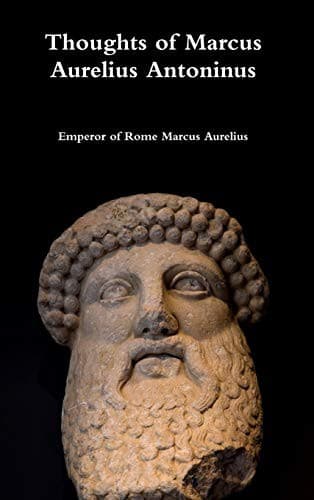
Thoughts of Marcus Aurelius AntoninusMarcus Aurelius, Emperor of Rome
PhilosophyPhilosophy
Thoughts of Marcus Aurelius Antoninus
Marcus Aurelius, Emperor of Rome
Ethics; Life; Marcus Aurelius, Emperor of Rome, 121-180; Stoics
21. He who has not one and always the same object in life, cannot be one
and the same all through his life. But what I have said is not enough,
unless this also is added, what this object ought to be. For as there is
not the same opinion about all the things which in some way or other are
considered by the majority to be good, but only about some certain
things, that is, things which concern the common interest, so also ought
we to propose to ourselves an object which shall be of a common kind
[social] and political. For he who directs all his own efforts to this
object, will make all his acts alike, and thus will always be the same.
22. Think of the country mouse and of the town mouse, and of the alarm
and trepidation of the town mouse.[A]
23. Socrates used to call the opinions of the many by the name of
Lamiae,--bugbears to frighten children.
24. The Lacedaemonians at their public spectacles used to set seats in
the shade for strangers, but themselves sat down anywhere.
25. Socrates excused himself to Perdiccas[B] for not going to him,
saying, It is because I would not perish by the worst of all ends; that
is, I would not receive a favor and then be unable to return it.
26. In the writings of the [Ephesians][C] there was this precept,
constantly to think of some one of the men of former times who practiced
virtue.
[A] The story is told by Horace in his Satires (ii. 6), and by
others since but not better.
[B] Perhaps the emperor made a mistake here, for other writers
say that it was Archelaus, the son of Perdiccas, who invited
Socrates to Macedonia.
[C] Gataker suggested [Greek: Epekoureiôn] for [Greek:
Ephesiôn].
27. The Pythagoreans bid us in the morning look to the heavens that we
may be reminded of those bodies which continually do the same things
and in the same manner perform their work, and also be reminded of their
purity and nudity. For there is no veil over a star.
28. Consider what a man Socrates was when he dressed himself in a skin,
after Xanthippe had taken his cloak and gone out, and what Socrates said
to his friends who were ashamed of him and drew back from him when they
saw him dressed thus.
29. Neither in writing nor in reading wilt thou be able to lay down
rules for others before thou shalt have first learned to obey rules
thyself. Much more is this so in life.
30. A slave thou art: free speech is not for thee.
31. And my heart laughed within.
_Odyssey_, ix. 413.
32. And virtue they will curse, speaking harsh words.
HESIOD, _Works and Days_, 184.
33. To look for the fig in winter is a mad-man's act: such is he who
looks for his child when it is no longer allowed (Epictetus, iii. 24,
87).
Public-domain text, read in full here on John Shaqi.
Reviews
Reviews
No reviews yet
Be the first to share your thoughts on this work.
Elsewhere in the archive
Join the Discussion
Join the discussion
Sign in to leave a comment or review.
Sign InorCreate an account