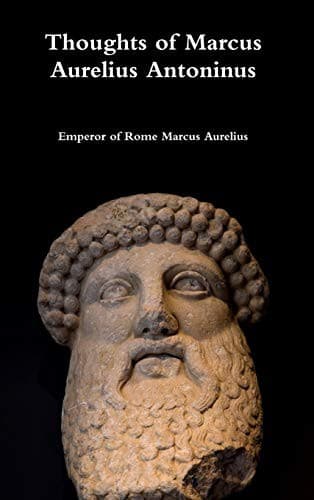
Thoughts of Marcus Aurelius AntoninusMarcus Aurelius, Emperor of Rome
PhilosophyPhilosophy
Thoughts of Marcus Aurelius Antoninus
Marcus Aurelius, Emperor of Rome
Ethics; Life; Marcus Aurelius, Emperor of Rome, 121-180; Stoics
33. Neither the labor which the hand does nor that of the foot is
contrary to nature, so long as the foot does the foot's work and the
hand the hand's. So then neither to a man as a man is his labor contrary
to nature, so long as it does the things of a man. But if the labor is
not contrary to his nature, neither is it an evil to him.
34. How many pleasures have been enjoyed by robbers, patricides,
tyrants.
35. Dost thou not see how the handicrafts-men accommodate themselves up
to a certain point to those who are not skilled in their
craft--nevertheless they cling to the reason [the principles] of their
art, and do not endure to depart from it? Is it not strange if the
architect and the physician shall have more respect to the reason [the
principles] of their own arts than man to his own reason, which is
common to him and the gods?
36. Asia, Europe, are corners of the universe; all the sea a drop in the
universe; Athos a little clod of the universe: all the present time is a
point in eternity. All things are little, changeable, perishable. All
things come from thence, from that universal ruling power, either
directly proceeding or by way of sequence. And accordingly the lion's
gaping jaws, and that which is poisonous, and every harmful thing, as a
thorn, as mud, are after-products of the grand and beautiful. Do not
then imagine that they are of another kind from that which thou dost
venerate, but form a just opinion of the source of all (vii. 75).
37. He who has seen present things has seen all, both everything which
has taken place from all eternity and everything which will be for time
without end; for all things are of one kin and of one form.
38. Frequently consider the connection of all things in the universe and
their relation to one another. For in a manner all things are implicated
with one another, and all in this way are friendly to one another; for
one thing comes in order after another, and this is by virtue of the +
active movement and mutual conspiration and the unity of the substance
(ix. 1).
39. Adapt thyself to the things with which thy lot has been cast: and
the men among whom thou hast received thy portion, love them, but do it
truly [sincerely].
40. Every instrument, tool, vessel, if it does that for which it has
been made, is well, and yet he who made it is not there. But in the
things which are held together by nature there is within, and there
abides in them the power which made them; wherefore the more is it fit
to reverence this power, and to think, that, if thou dost live and act
according to its will, everything in thee is in conformity to
intelligence. And thus also in the universe the things which belong to
it are in conformity to intelligence.
Public-domain text, read in full here on John Shaqi.
Reviews
Reviews
No reviews yet
Be the first to share your thoughts on this work.
Elsewhere in the archive
Join the Discussion
Join the discussion
Sign in to leave a comment or review.
Sign InorCreate an account