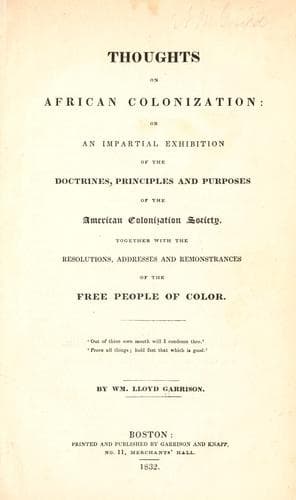
Thoughts on African ColonizationGarrison, William Lloyd
Philosophy
Thoughts on African Colonization
Garrison, William Lloyd
African Americans -- Colonization -- Africa; American Colonization Society; Slavery -- United States
'The fact was most glaring, without an inquiry, that the same
shackles which bound them, fastened them also to the resources
of the soil, and the interests of the community; and when these
were broken, and the incentives of authority removed, the weight
of ignorance, the want of better incentives, and the fatal and
untried power of grateful but ruinous idleness, sunk them to a
state, which, however elevated in theory, was in fact more
degraded and more miserable than that of bondage. In addition to
all this, pauperism, with the numerous evils of corrupt and
corrupting indolence, threatened to impose its sluggish weight
upon a groaning community. Hence, the progress of emancipation
was, for the time, most righteously arrested.'--[Address of the
Board of Managers of the African Education Society.]
'Who are the free people of color in the United States? In what
circumstances does philanthropy find them! There are indeed
individuals and families, who are sober, industrious, pious. But
what are the remainder, the mass? Every one knows that their
condition is deep and wretched degradation; but, only a few have
ever formed any accurate conception of the reality. The fact is,
that as a class they are branded. They have no home, no country,
no such personal interest in the welfare of the community, as
gives a certain degree of manliness to almost every white
man.... Three hundred thousand freemen in this country, are
freemen only in name, forming only little else than a mass of
pauperism and crime.... Here the black man is paralysed and
crushed by the constant sense of inferiority. He has no
effectual incentives to manly enterprise. He stands in a
degraded class of society; and out of that class he never dreams
of rising.'--[Christian Spectator.]
'This is the true condition of the free colored population of
our land. They are placed mid way between freedom and slavery;
they feel neither the moral stimulants of the one, nor the
restraints of the other, and are alike injurious to every other
class of the community.'--[Southern Religious Telegraph.]
Public-domain text, read in full here on John Shaqi.
Reviews
Reviews
No reviews yet
Be the first to share your thoughts on this work.
Elsewhere in the archive
Join the Discussion
Join the discussion
Sign in to leave a comment or review.
Sign InorCreate an account