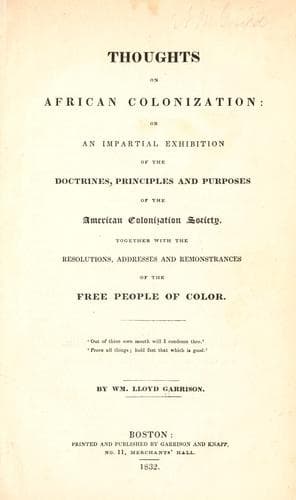
Thoughts on African ColonizationGarrison, William Lloyd
Philosophy
Thoughts on African Colonization
Garrison, William Lloyd
African Americans -- Colonization -- Africa; American Colonization Society; Slavery -- United States
'Incorporated into our country as freemen, yet separated from it
by odious and degrading distinctions, they feel themselves
condemned to a hopeless and debasing inferiority. They know that
their very complexion will _for ever_ exclude them from the
rank, the privileges, the honors, of freemen. No matter how
great their industry, or how abundant their wealth--no matter
what their attainments in literature, science or the arts--no
matter how correct their deportment or what respect their
characters may inspire, they can never, NO, NEVER be raised to a
footing of equality, not even to a familiar intercourse with the
surrounding society.' * * 'To us it seems evident that the man
of color may as soon _change his complexion_, as rise above all
sense of past inferiority and debasement in a community, from
the social intercourse of which, he must expect to be in a great
measure excluded, not only until prejudice shall have no
existence therein, but until the freedom of man in regulating
his social relations is proved to be abridged by some law of
morality or the gospel.... Is it not _wise_, then, for the free
people of color and their friends to _admit_, what cannot
reasonably be doubted, that the people of color must, in this
country, remain for ages, _probably for ever_, a separate and
inferior caste, weighed down by causes, powerful, universal,
inevitable; _which neither legislation nor christianity can
remove?_'
'Let the free black in this country toil from youth to age in
the honorable pursuit of wisdom--let him store his mind with the
most valuable researches of science and literature--and let him
add to a highly gifted and cultivated intellect, a piety pure,
undefiled, and "unspotted from the world"--it is all nothing: he
would not be received into the very lowest walks of society. If
we were constrained to admire so uncommon a being, our very
admiration would mingle with disgust, because, in the physical
organization of his frame, we meet an insurmountable barrier,
even to an approach to social intercourse, and in the Egyptian
color, which nature has stamped upon his features, a principle
of repulsion so strong as to forbid the idea of a communion
either of interest or of feeling, as utterly abhorrent. Whether
these feelings are founded in reason or not, we will not now
inquire--perhaps they are not. But education and habit and
prejudice have so firmly riveted them upon us, that they have
become as strong as nature itself--and to expect their removal,
or even their slightest modification, would be as idle and
preposterous as to expect that we could reach forth our hands,
and remove the mountains from their foundations into the
vallies, which are beneath them.'--[African Repository, vol.
vii. pp. 100, 195, 196, 231.]
Public-domain text, read in full here on John Shaqi.
Reviews
Reviews
No reviews yet
Be the first to share your thoughts on this work.
Elsewhere in the archive
Join the Discussion
Join the discussion
Sign in to leave a comment or review.
Sign InorCreate an account