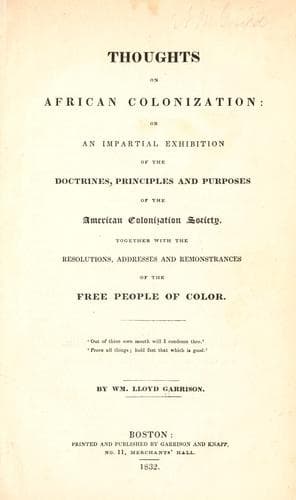
Thoughts on African ColonizationGarrison, William Lloyd
Philosophy
Thoughts on African Colonization
Garrison, William Lloyd
African Americans -- Colonization -- Africa; American Colonization Society; Slavery -- United States
Again I ask, are we pagans, are we savages, are we devils? Search the
records of heathenism, and sentiments more hostile to the spirit of the
gospel, or of a more black and blasphemous complexion than these, cannot
be found. I believe that they are libels upon the character of my
countrymen, which time will wipe off. I call upon the spirits of the
just made perfect in heaven, upon all who have experienced the love of
God in their souls here below, upon the christian converts in India and
the islands of the sea, to sustain me in the assertion that there _is_
power enough in the religion of Jesus Christ to melt down the most
stubborn prejudices, to overthrow the highest walls of partition, to
break the strongest caste, to improve and elevate the most degraded, to
unite in fellowship the most hostile, and to equalize and bless all its
recipients. Make me _sure_ that there is not, and I will give it up, now
and for ever. 'In Christ Jesus, all are one: there is neither Jew nor
Greek, there is neither bond nor free, there is neither male nor
female.'
These sentiments were not uttered by infidels, nor by worthless
wretches, but in many instances by professors of religion and _ministers
of the gospel_! and in almost every instance by reputedly the most
enlightened, patriotic and benevolent men in the land! Tell it not
abroad! publish it not in the streets of Calcutta! Even the eminent
President of Union College, (Rev. Dr. Nott,) could so far depart,
unguardedly I hope, from christian love and integrity, as to utter this
language in an address in behalf of the Colonization Society:--'With us
they [the free people of color] have been degraded by slavery, and
_still further degraded by the mockery of nominal freedom_.' Were this
true, it would imply that we of the free States are more barbarous and
neglectful than even the traffickers in souls and men-stealers at the
south. We have not, it is certain, treated our colored brethren as the
law of kindness and the ties of brotherhood demand; but have we outdone
slaveholders in cruelty? Were it true, to forge new fetters for the
limbs of these degraded beings would be an act of benevolence. But their
condition is as much superior to that of the slaves, as happiness is to
misery. The second portion of this work, containing their proceedings in
a collective capacity, shows whether they have made any progress in
intelligence, in virtue, in piety, and in happiness, since their
liberation. Again he says: '_We have endeavored_, but endeavored in
vain, _to restore them either to self-respect, or to the respect of
others_.' It is painful to contradict so worthy an individual; but
nothing is more certain than that this statement is altogether
erroneous. We have derided, we have shunned, we have neglected them, in
every possible manner. They have had to rise not only under the
mountainous weight of their own ignorance and vice, but with the
additional and constant pressure of our contempt and injustice. In
Public-domain text, read in full here on John Shaqi.
Reviews
Reviews
No reviews yet
Be the first to share your thoughts on this work.
Elsewhere in the archive
Join the Discussion
Join the discussion
Sign in to leave a comment or review.
Sign InorCreate an account