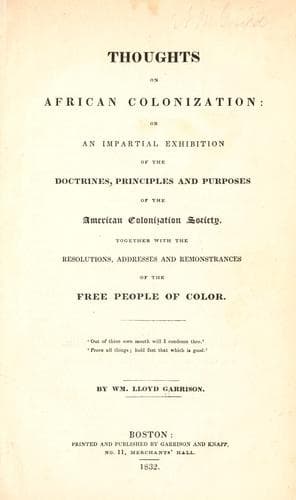
Thoughts on African ColonizationGarrison, William Lloyd
Philosophy
Thoughts on African Colonization
Garrison, William Lloyd
African Americans -- Colonization -- Africa; American Colonization Society; Slavery -- United States
prefers such means as these to the course proposed in this bill?
And one or the other is inevitable. For no matter how you change
this bill--sooner or later the free negroes will be _forced_ to
leave the State. Indeed, Sir, ALL OF US LOOK TO FORCE of some
kind or other, direct or indirect, moral or physical, legal or
illegal. Many who are opposed, they say, to any compulsory
feature in the bill, desire to introduce such severe regulations
into our police laws--such restrictions of their existing
privileges--such inability to hold property--obtain
employment--rent residences, &c., as to make it impossible for
them to remain amongst us. _Is not this force?_'
Mr Fisher said:
'If we wait until the free negroes consent to leave the State,
we shall wait until "time is no more." _They never will give
their consent_; and if the House amend the bill as proposed,
their consent is in a manner pointed out by the gentleman from
Dinwiddie--and it is a great question whether we shall force the
people to extort their consent from them in this way.--He
believed if the compulsory principle were stricken out, this
class of people would be forced to leave by the harsh treatment
of the whites. The people in those parts of the State where they
most abound, were determined,--as far as they could learn
through the newspapers and other sources,--to get rid of the
blacks.'
What a revelation, what a confession, is here! The free blacks taken
from their beds, and severely flagellated, to make them willing to
emigrate! And legislative compulsion openly advocated to accomplish this
nefarious project! Yes, the gentlemen say truly, 'few, very few will
_voluntarily_ consent to emigrate'--'they never will give their
consent'--and therefore they must be expelled by force! It is true, the
bill proposed by Mr Broadnax was rejected by a small majority; but it
serves to illustrate the spirit of the colonization leaders.
The editor of the Lynchburg Virginian, an advocate of the Society, uses
the following language:
Public-domain text, read in full here on John Shaqi.
Reviews
Reviews
No reviews yet
Be the first to share your thoughts on this work.
Elsewhere in the archive
Join the Discussion
Join the discussion
Sign in to leave a comment or review.
Sign InorCreate an account