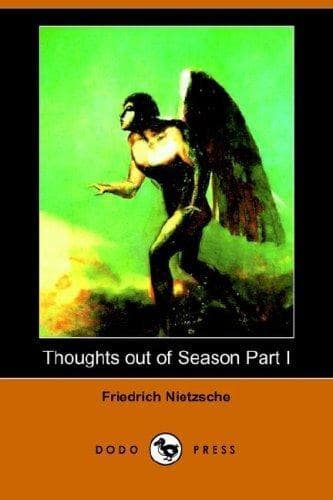
Thoughts out of Season, Part INietzsche, Friedrich Wilhelm
PhilosophyPhilosophy
Thoughts out of Season, Part I
Nietzsche, Friedrich Wilhelm
Philosophy, German; Strauss, David Friedrich, 1808-1874; Wagner, Richard, 1813-1883
cover of half measures and subterfuges, as a shield against the masses
and as a support of this society and its possessions, and finally how
science and men of learning pliantly consented to become its
drudges--all this Wagner traced through the ages, only to be convulsed
with loathing at the end of his researches. Through his compassion for
the people, he became a revolutionist. From that time forward he loved
them and longed for them, as he longed for his art; for, alas! in them
alone, in this fast disappearing, scarcely recognisable body,
artificially held aloof, he now saw the only spectators and listeners
worthy and fit for the power of his masterpieces, as he pictured them.
Thus his thoughts concentrated themselves upon the question, How do
the people come into being? How are they resuscitated?
He always found but one answer: if a large number of people were
afflicted with the sorrow that afflicted him, that number would
constitute the people, he said to himself. And where the same sorrow
leads to the same impulses and desires, similar satisfaction would
necessarily be sought, and the same pleasure found in this
satisfaction. If he inquired into what it was that most consoled him
and revived his spirits in his sorrow, what it was that succeeded best
in counteracting his affliction, it was with joyful certainty that he
discovered this force only in music and myth, the latter of which he
had already recognised as the people's creation and their language of
distress. It seemed to him that the origin of music must be similar,
though perhaps more mysterious. In both of these elements he steeped
and healed his soul; they constituted his most urgent need:--in this
way he was able to ascertain how like his sorrow was to that of the
people, when they came into being, and how they must arise anew if
many Wagners are going to appear. What part did myth and music play in
modern society, wherever they had not been actually sacrificed to it?
They shared very much the same fate, a fact which only tends to prove
their close relationship: myth had been sadly debased and usurped by
idle tales and stories; completely divested of its earnest and sacred
virility, it was transformed into the plaything and pleasing bauble of
children and women of the afflicted people. Music had kept itself
alive among the poor, the simple, and the isolated; the German
musician had not succeeded in adapting himself to the luxurious
traffic of the arts; he himself had become a fairy tale full Of
monsters and mysteries, full of the most touching omens and
auguries--a helpless questioner, something bewitched and in need of
rescue. Here the artist distinctly heard the command that concerned
him alone--to recast myth and make it virile, to break the spell lying
over music and to make music speak: he felt his strength for drama
liberated at one stroke, and the foundation of his sway established
over the hitherto undiscovered province lying between myth and music.
Public-domain text, read in full here on John Shaqi.
Reviews
Reviews
No reviews yet
Be the first to share your thoughts on this work.
Elsewhere in the archive
Join the Discussion
Join the discussion
Sign in to leave a comment or review.
Sign InorCreate an account