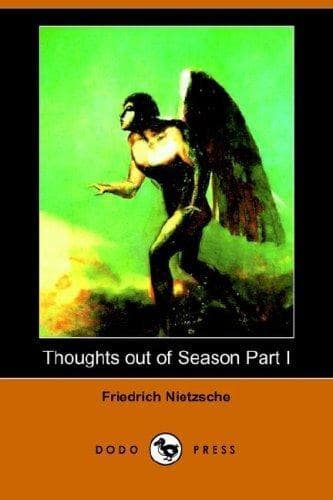
Thoughts out of Season, Part INietzsche, Friedrich Wilhelm
PhilosophyPhilosophy
Thoughts out of Season, Part I
Nietzsche, Friedrich Wilhelm
Philosophy, German; Strauss, David Friedrich, 1808-1874; Wagner, Richard, 1813-1883
and equipped himself for the task of completing at his ease that
gigantic edifice in four parts which he had long ago planned and
begun--the ultimate result of all his meditations and poetical flights
for over twenty years, his Bayreuth masterpiece, the Ring of the
Nibelung! He who marvels at the rapid succession of the two operas,
Tristan and the Meistersingers, has failed to understand one important
side of the life and nature of all great Germans: he does not know the
peculiar soil out of which that essentially German gaiety, which
characterised Luther, Beethoven, and Wagner, can grow, the gaiety
which other nations quite fail to understand and which even seems to
be missing in the Germans of to-day--that clear golden and thoroughly
fermented mixture of simplicity, deeply discriminating love,
observation, and roguishness which Wagner has dispensed, as the most
precious of drinks, to all those who have suffered deeply through
life, but who nevertheless return to it with the smile of
convalescents. And, as he also turned upon the world the eyes of one
reconciled, he was more filled with rage and disgust than with sorrow,
and more prone to renounce the love of power than to shrink in awe
from it. As he thus silently furthered his greatest work and gradually
laid score upon score, something happened which caused him to stop and
listen: friends were coming, a kind of subterranean movement of many
souls approached with a message for him--it was still far from being
the people that constituted this movement and which wished to bear him
news, but it may have been the nucleus and first living source of a
really human community which would reach perfection in some age still
remote. For the present they only brought him the warrant that his
great work could be entrusted to the care and charge of faithful men,
men who would watch and be worthy to watch over this most magnificent
of all legacies to posterity. In the love of friends his outlook began
to glow with brighter colours; his noblest care--the care that his
work should be accomplished and should find a refuge before the
evening of his life--was not his only preoccupation. something
occurred which he could only understand as a symbol: it was as much as
a new comfort and a new token of happiness to him. A great German war
caused him to open his eyes, and he observed that those very Germans
whom he considered so thoroughly degenerate and so inferior to the
high standard of real Teutonism, of which he had formed an ideal both
from self-knowledge and the conscientious study of other great Germans
in history; he observed that those very Germans were, in the midst of
terrible circumstances, exhibiting two virtues of the highest
order--simple bravery and prudence; and with his heart bounding with
delight he conceived the hope that he might not be the last German,
and that some day a greater power would perhaps stand by his works
than that devoted yet meagre one consisting of his little band of
Public-domain text, read in full here on John Shaqi.
Reviews
Reviews
No reviews yet
Be the first to share your thoughts on this work.
Elsewhere in the archive
Join the Discussion
Join the discussion
Sign in to leave a comment or review.
Sign InorCreate an account