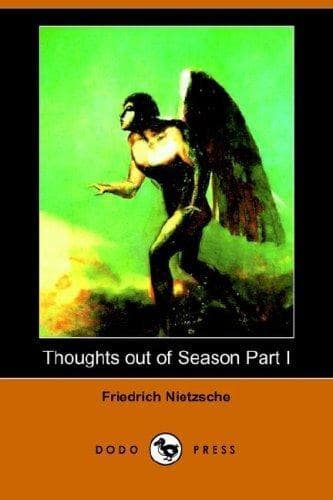
Thoughts out of Season, Part INietzsche, Friedrich Wilhelm
PhilosophyPhilosophy
Thoughts out of Season, Part I
Nietzsche, Friedrich Wilhelm
Philosophy, German; Strauss, David Friedrich, 1808-1874; Wagner, Richard, 1813-1883
other saying of Lessing's-- 'If God, holding truth in His right hand,
and in His left only the ever-living desire for it, although on
condition of perpetual error, left him the choice of the two, he
would, considering that truth belongs to God alone, humbly seize His
left hand, and beg its contents for Himself'-- this saying of
Lessing's has always been accounted one of the most magnificent which
he has left us. It has been found to contain the general expression of
his restless love of inquiry and activity. The saying has always made
a special impression upon me; because, behind its subjective meaning,
I still seemed to hear the faint ring of an objective one of infinite
import. For does it not contain the best possible answer to the rude
speech of Schopenhauer, respecting the ill-advised God who had nothing
better to do than to transform Himself into this miserable world? if,
for example, the Creator Himself had shared Lessing's conviction of
the superiority of struggle to tranquil possession?" What!--a God who
would choose perpetual error, together with a striving after truth,
and who would, perhaps, fall humbly at Strauss's feet and cry to
him,"Take thou all Truth, it is thine!"? If ever a God and a man were
ill-advised, they are this Straussian God, whose hobby is to err and
to fail, and this Straussian man, who must atone for this erring and
failing. Here, indeed, one hears "a faint ring of infinite import";
here flows Strauss's cosmic soothing oil; here one has a notion of the
rationale of all becoming and all natural laws. Really? Is not our
universe rather the work of an inferior being, as Lichtenberg
suggests?--of an inferior being who did not quite understand his
business; therefore an experiment, an attempt, upon which work is
still proceeding? Strauss himself, then, would be compelled to admit
that our universe is by no means the theatre of reason, but of error,
and that no conformity to law can contain anything consoling, since
all laws have been promulgated by an erratic God who even finds
pleasure in blundering. It really is a most amusing spectacle to watch
Strauss as a metaphysical architect, building castles in the air. But
for whose benefit is this entertainment given? For the smug and noble
"We," that they may not lose conceit with themselves: they may
possibly have taken sudden fright, in the midst of the inflexible and
pitiless wheel-works of the world-machine, and are tremulously
imploring their leader to come to their aid. That is why Strauss pours
forth the "soothing oil," that is why he leads forth on a leash a God
whose passion it is to err; it is for the same reason, too, that he
assumes for once the utterly unsuitable rôle of a metaphysical
architect. He does all this, because the noble souls already referred
to are frightened, and because he is too. And it is here that we reach
the limit of his courage, even in the presence of his "We." He does
not dare to be honest, and to tell them, for instance: "I have
Public-domain text, read in full here on John Shaqi.
Reviews
Reviews
No reviews yet
Be the first to share your thoughts on this work.
Join the Discussion
Join the discussion
Sign in to leave a comment or review.
Sign InorCreate an account