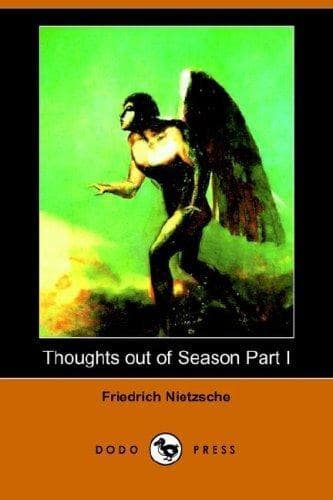
Thoughts out of Season, Part INietzsche, Friedrich Wilhelm
PhilosophyPhilosophy
Thoughts out of Season, Part I
Nietzsche, Friedrich Wilhelm
Philosophy, German; Strauss, David Friedrich, 1808-1874; Wagner, Richard, 1813-1883
And it is just to this kind of discomfort that Wagner always felt
himself drawn by his study of history and philosophy: in them he not
only found arms and coats of mail, but what he felt in their presence
above all was the inspiring breath which is wafted from the graves of
all great fighters, sufferers, and thinkers. Nothing distinguishes a
man more from the general pattern of the age than the use he makes of
history and philosophy. According to present views, the former seems
to have been allotted the duty of giving modern man breathing-time, in
the midst of his panting and strenuous scurry towards his goal, so
that he may, for a space, imagine he has slipped his leash. What
Montaigne was as an individual amid the turmoil of the
Reformation--that is to say, a creature inwardly coming to peace with
himself, serenely secluded in himself and taking breath, as his best
reader, Shakespeare, understood him, --this is what history is to the
modern spirit today. The fact that the Germans, for a whole century,
have devoted themselves more particularly to the study of history,
only tends to prove that they are the stemming, retarding, and
becalming force in the activity of modern society--a circumstance
which some, of course, will place to their credit. On the whole,
however, it is a dangerous symptom when the mind of a nation turns
with preference to the study of the past. It is a sign of flagging
strength, of decline and degeneration; it denotes that its people are
perilously near to falling victims to the first fever that may happen
to be rife --the political fever among others. Now, in the history of
modern thought, our scholars are an example of this condition of
weakness as opposed to all reformative and revolutionary activity. The
mission they have chosen is not of the noblest; they have rather been
content to secure smug happiness for their kind, and little more.
Every independent and manly step leaves them halting in the
background, although it by no means outstrips history. For the latter
is possessed of vastly different powers, which only natures like
Wagner have any notion of; but it requires to be written in a much
more earnest and severe spirit, by much more vigorous students, and
with much less optimism than has been the case hitherto. In fact, it
requires to be treated quite differently from the way German scholars
have treated it until now. In all their works there is a continual
desire to embellish, to submit and to be content, while the course of
events invariably seems to have their approbation. It is rather the
exception for one of them to imply that he is satisfied only because
things might have turned out worse; for most of them believe, almost
as a matter of course, that everything has been for the best simply
because it has only happened once. Were history not always a disguised
Christian theodicy, were it written with more justice and fervent
feeling, it would be the very last thing on earth to be made to serve
Public-domain text, read in full here on John Shaqi.
Reviews
Reviews
No reviews yet
Be the first to share your thoughts on this work.
Elsewhere in the archive
Join the Discussion
Join the discussion
Sign in to leave a comment or review.
Sign InorCreate an account