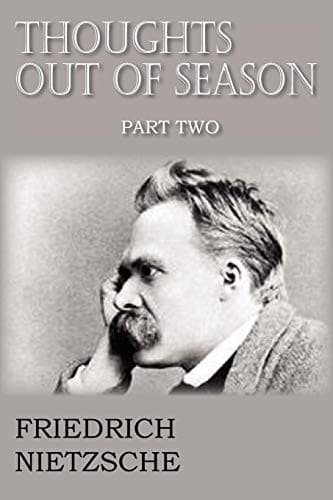
Thoughts Out of Season, Part IINietzsche, Friedrich Wilhelm
PhilosophyPhilosophy
Thoughts Out of Season, Part II
Nietzsche, Friedrich Wilhelm
History -- Study and teaching; Schopenhauer, Arthur, 1788-1860
The following characteristics of the savant are less common, but
still found.--Firstly, downrightness and a feeling for simplicity,
very valuable if more than a mere awkwardness and inability to
deceive, deception requiring some mother-wit.--(Actually, we may be
on our guard against too obvious cleverness and resource, and doubt
the man's sincerity.)--Otherwise this downrightness is generally of
little value, and rarely of any use to knowledge, as it follows
tradition and speaks the truth only in "adiaphora"; it being lazier
to speak the truth here than ignore it. Everything new means
something to be unlearnt, and your downright man will respect the
ancient dogmas and accuse the new evangelist of failing in the
_sensus recti_. There was a similar opposition, with probability and
custom on its side, to the theory of Copernicus. The professor's
frequent hatred of philosophy is principally a hatred of the long
trains of reasoning and artificiality of the proofs. Ultimately the
savants of every age have a fixed limit; beyond which ingenuity is
not allowed, and everything suspected as a conspirator against
honesty.
Secondly, a clear vision of near objects, combined with great
shortsightedness for the distant and universal. The professor's range
is generally very small, and his eye must be kept close to the
object. To pass from a point already considered to another, he has to
move his whole optical apparatus. He cuts a picture into small
sections, like a man using an opera-glass in the theatre, and sees
now a head, now a bit of the dress, but nothing as a whole. The
single sections are never combined for him, he only infers their
connection, and consequently has no strong general impression. He
judges a literary work, for example, by certain paragraphs or
sentences or errors, as he can do nothing more; he will be driven to
see in an oil painting nothing but a mass of daubs.
Thirdly, a sober conventionality in his likes and dislikes. Thus he
especially delights in history because he can put his own motives
into the actions of the past. A mole is most comfortable in a
mole-hill. He is on his guard against all ingenious and extravagant
hypotheses; but digs up industriously all the commonplace motives of
the past, because he feels in sympathy with them. He is generally
quite incapable of understanding and valuing the rare or the
uncommon, the great or the real.
Fourthly, a lack of feeling, which makes him capable of vivisection.
He knows nothing of the suffering that brings knowledge, and does not
fear to tread where other men shudder. He is cold and may easily
appear cruel. He is thought courageous, but he is not,--any more than
the mule who does not feel giddiness.
Fifthly, diffidence, or a low estimate of himself. Though he live in
a miserable alley of the world, he has no sense of sacrifice or
surrender; he appears often to know in his inmost heart that he is
not a flying but a crawling creature. And this makes him seem even
pathetic.
Public-domain text, read in full here on John Shaqi.
Reviews
Reviews
No reviews yet
Be the first to share your thoughts on this work.
Elsewhere in the archive
Join the Discussion
Join the discussion
Sign in to leave a comment or review.
Sign InorCreate an account