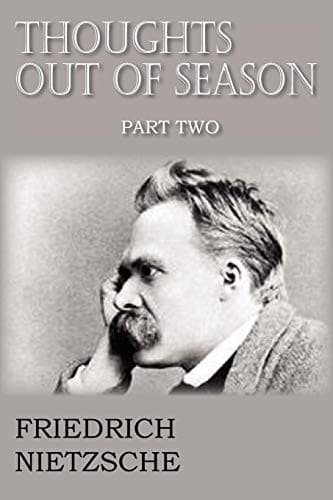
Thoughts Out of Season, Part IINietzsche, Friedrich Wilhelm
PhilosophyPhilosophy
Thoughts Out of Season, Part II
Nietzsche, Friedrich Wilhelm
History -- Study and teaching; Schopenhauer, Arthur, 1788-1860
Eleventhly, the "savant for vanity," now rather rare. He will get a
department for himself somehow, and investigate curiosities,
especially if they demand unusual expenditure, travel, research, or
communication with all parts of the world. He is quite satisfied with
the honour of being regarded as a curiosity himself, and never dreams
of earning a living by his erudite studies.
Twelfthly, the "savant for amusement." He loves to look for knots in
knowledge and to untie them; not too energetically however, lest he
lose the spirit of the game. Thus he does not penetrate the depths,
though he often observes something that the microscopic eyes of the
bread-and-butter scientist never see.
If I speak, lastly, of the "impulse towards justice" as a further
motive of the savant, I may be answered that this noble impulse,
being metaphysical in its nature, is too indistinguishable from the
rest, and really incomprehensible to mortal mind; and so I leave the
thirteenth heading with the pious wish that the impulse may be less
rare in the professor than it seems. For a spark in his soul from the
fire of justice is sufficient to irradiate and purify it, so that he
can rest no more and is driven for ever from the cold or lukewarm
condition in which most of his fellows do their daily work.
All these elements, or a part of them, must be regarded as fused and
pounded together, to form the Servant of Truth. For the sake of an
absolutely inhuman thing--mere purposeless, and therefore motiveless,
knowledge--a mass of very human little motives have been chemically
combined, and as the result we have the professor,--so transfigured
in the light of that pure unearthly object that the mixing and
pounding which went to form him are all forgotten! It is very
curious. Yet there are moments when they must be remembered,--when we
have to think of the professor's significance to culture. Any one
with observation can see that he is in his essence and by his origin
unproductive, and has a natural hatred of the productive; and thus
there is an endless feud between the genius and the savant in idea
and practice. The latter wishes to kill Nature by analysing and
comprehending it, the former to increase it by a new living Nature.
The happy age does not need or know the savant; the sick and sluggish
time ranks him as its highest and worthiest.
Who were physician enough to know the health or sickness of our time?
It is clear that the professor is valued too highly, with evil
consequences for the future genius, for whom he has no compassion,
merely a cold, contemptuous criticism, a shrug of the shoulders, as
if at something strange and perverted for which he has neither time
nor inclination. And so he too knows nothing of the aim of culture.
Public-domain text, read in full here on John Shaqi.
Reviews
Reviews
No reviews yet
Be the first to share your thoughts on this work.
Elsewhere in the archive
Join the Discussion
Join the discussion
Sign in to leave a comment or review.
Sign InorCreate an account