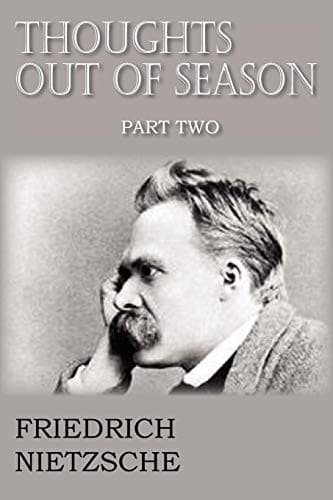
Thoughts Out of Season, Part IINietzsche, Friedrich Wilhelm
PhilosophyPhilosophy
Thoughts Out of Season, Part II
Nietzsche, Friedrich Wilhelm
History -- Study and teaching; Schopenhauer, Arthur, 1788-1860
It requires a totally new attitude of mind to be able to look away
from the present educational institutions to the strangely different
ones that will be necessary for the second or third generation. At
present the labours of higher education produce merely the savant or
the official or the business man or the Philistine or, more commonly,
a mixture of all four; and the future institutions will have a harder
task;--not in itself harder; as it is really more natural, and so
easier; and further, could anything be harder than to make a youth
into a savant against nature, as now happens?--But the difficulty
lies in unlearning what we know and setting up a new aim; it will be
an endless trouble to change the fundamental idea of our present
educational system, that has its roots in the Middle Ages and regards
the mediæval savant as the ideal type of culture. It is already time
to put these objects before us; for some generation must begin the
battle, of which a later generation will reap the victory. The
solitary man who has understood the new fundamental idea of culture
is at the parting of the ways; on the one he will be welcomed by his
age, laurels and rewards will be his, powerful parties will uphold
him, he will have as many in sympathy behind him as in front, and
when the leader speaks the word of deliverance, it will echo through
all the ranks. The first duty is to "fight in line," the second to
treat as foes all who will not "fall in." On the other way he will
find fewer companions; it is steeper and more tortuous. The
travellers on the first road laugh at him, as his way is the more
troublesome and dangerous; and they try to entice him over. If the
two ways cross, he is ill-treated, cast aside or left alone. What
significance has any particular form of culture for these several
travellers? The enormous throng that press to their end on the first
road, understand by it the laws and institutions that enable them to
go forward in regular fashion and rule out all the solitary and
obstinate people who look towards higher and remoter objects. To the
small company on the other road it has quite a different office: they
wish to guard themselves, by means of a strong organisation, from
being swept away by the throng, to prevent their individual members
from fainting on the way or turning in spirit from their great task.
These solitary men must finish their work; that is why they should
all hold together; and those who have their part in the scheme will
take thought to prepare themselves with ever-increasing purity of aim
for the birth of the genius, and ensure that the time be ripe for
him. Many are destined to help on the labour, even among the
second-rate talents, and it is only in submission to such a destiny
that they can feel they are living for a duty, and have a meaning and
an object in their lives. But at present these talents are being
turned from the road their instinct has chosen by the seductive tones
Public-domain text, read in full here on John Shaqi.
Reviews
Reviews
No reviews yet
Be the first to share your thoughts on this work.
Elsewhere in the archive
Join the Discussion
Join the discussion
Sign in to leave a comment or review.
Sign InorCreate an account