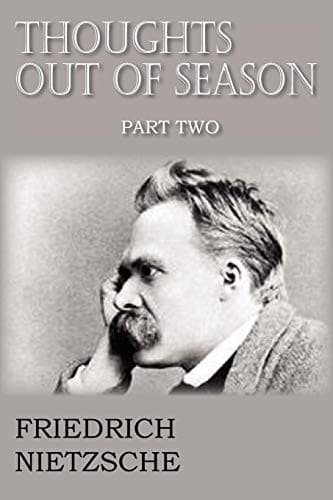
Thoughts Out of Season, Part IINietzsche, Friedrich Wilhelm
PhilosophyPhilosophy
Thoughts Out of Season, Part II
Nietzsche, Friedrich Wilhelm
History -- Study and teaching; Schopenhauer, Arthur, 1788-1860
Nature always desires the greatest utility, but does not understand
how to find the best and handiest means to her end; that is her great
sorrow, and the cause of her melancholy. The impulse towards her own
redemption shows clearly her wish to give men a significant existence
by the generation of the philosopher and the artist: but how unclear
and weak is the effect she generally obtains with her artists and
philosophers, and how seldom is there any effect at all! She is
especially perplexed in her efforts to make the philosopher useful;
her methods are casual and tentative, her failures innumerable; most
of her philosophers never touch the common good of mankind at all.
Her actions seem those of a spendthrift; but the cause lies in no
prodigal luxury, but in her inexperience. Were she human, she would
probably never cease to be dissatisfied with herself and her
bungling. Nature shoots the philosopher at mankind like an arrow; she
does not aim, but hopes that the arrow will stick somewhere. She
makes countless mistakes that give her pain. She is as extravagant in
the sphere of culture as in her planting and sowing. She fulfils her
ends in a large and clumsy fashion, using up far too much of her
strength. The artist has the same relation to the connoisseurs and
lovers of his art as a piece of heavy artillery to a flock of
sparrows. It is a fool's part to use a great avalanche to sweep away
a little snow, to kill a man in order to strike the fly on his nose.
The artist and the philosopher are witnesses against Nature's
adaptation of her means, however well they may show the wisdom of her
ends. They only reach a few and should reach all--and even these few
are not struck with the strength they used when they shot. It is sad
to have to value art so differently as cause and effect; how huge in
its inception, how faint the echo afterwards! The artist does his
work as Nature bids him, for the benefit of other men--no doubt of
it; but he knows that none of those men will understand and love his
work as he understands and loves it himself. That lonely height of
love and understanding is necessary, by Nature's clumsy law, to
produce a lower type; the great and noble are used as the means to
the small and ignoble. Nature is a bad manager; her expenses are far
greater than her profits: for all her riches she must one day go
bankrupt. She would have acted more reasonably to make the rule of
her household--small expense and hundredfold profit; if there had
been, for example, only a few artists with moderate powers, but an
immense number of hearers to appreciate them, stronger and more
powerful characters than the artists themselves; then the effect of
the art-work, in comparison with the cause, might be a hundred-tongued
echo. One might at least expect cause and effect to be of equal power;
but Nature lags infinitely behind this consummation. An artist, and
especially a philosopher, seems often to have dropped by chance into his
Public-domain text, read in full here on John Shaqi.
Reviews
Reviews
No reviews yet
Be the first to share your thoughts on this work.
Elsewhere in the archive
Join the Discussion
Join the discussion
Sign in to leave a comment or review.
Sign InorCreate an account