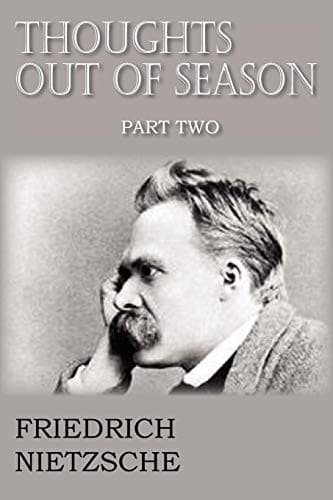
Thoughts Out of Season, Part IINietzsche, Friedrich Wilhelm
PhilosophyPhilosophy
Thoughts Out of Season, Part II
Nietzsche, Friedrich Wilhelm
History -- Study and teaching; Schopenhauer, Arthur, 1788-1860
manage our art, politics, religion and education--to say nothing of
our vases!--will find in them a barbaric exaggeration and
arbitrariness of expression. Nothing is more unfavourable to
the rise of genius than such monstrosities. They are unseen and
undiscoverable, the leaden weights on his hand when he will set it to
the plough; the weights are only shaken off with violence, and his
highest work must to an extent always bear the mark of it.
In considering the conditions that, at best, keep the born
philosopher from being oppressed by the perversity of the age, I am
surprised to find they are partly those in which Schopenhauer himself
grew up. True, there was no lack of opposing influences; the evil
time drew perilously near him in the person of a vain and pretentious
mother. But the proud republican character of his father rescued him
from her and gave him the first quality of a philosopher--a rude and
strong virility. His father was neither an official nor a savant; he
travelled much abroad with his son,--a great help to one who must
know men rather than books, and worship truth before the state. In
time he got accustomed to national peculiarities: he made England,
France and Italy equally his home, and felt no little sympathy with
the Spanish character. On the whole, he did not think it an honour to
be born in Germany, and I am not sure that the new political
conditions would have made him change his mind. He held quite openly
the opinion that the state's one object was to give protection at
home and abroad, and even protection against its "protectors," and to
attribute any other object to it was to endanger its true end. And
so, to the consternation of all the so-called liberals, he left his
property to the survivors of the Prussian soldiers who fell in 1848
in the fight for order. To understand the state and its duties in
this single sense may seem more and more henceforth the sign of
intellectual superiority; for the man with the _furor philosophicus_
in him will no longer have time for the _furor politicus_, and will
wisely keep from reading the newspapers or serving a party; though he
will not hesitate a moment to take his place in the ranks if his
country be in real need. All states are badly managed, when other men
than politicians busy themselves with politics; and they deserve to
be ruined by their political amateurs.
Public-domain text, read in full here on John Shaqi.
Reviews
Reviews
No reviews yet
Be the first to share your thoughts on this work.
Elsewhere in the archive
Join the Discussion
Join the discussion
Sign in to leave a comment or review.
Sign InorCreate an account