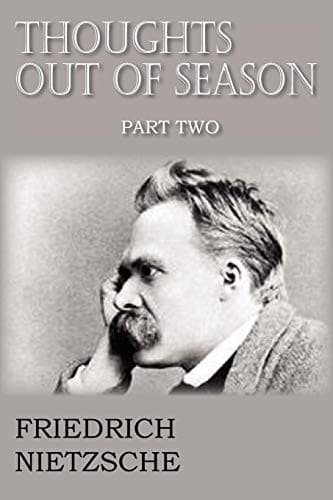
Thoughts Out of Season, Part IINietzsche, Friedrich Wilhelm
PhilosophyPhilosophy
Thoughts Out of Season, Part II
Nietzsche, Friedrich Wilhelm
History -- Study and teaching; Schopenhauer, Arthur, 1788-1860
The thoughtful reader will understand! Then one really could
misunderstand Hartmann! And what a splendid joke it is, that he
should be misunderstood! Why should the Germans of to-day be
particularly subtle? A valiant Englishman looks in vain for "delicacy
of perception" and dares to say that "in the German mind there does
seem to be something splay, something blunt-edged, unhandy and
infelicitous." Could the great German parodist contradict this?
According to him, we are approaching "that ideal condition in which
the human race makes its history with full consciousness": but we are
obviously far from the perhaps more ideal condition, in which mankind
can read Hartmann's book with full consciousness. If we once reach
it, the word "world-process" will never pass any man's lips again
without a smile. For he will remember the time when people listened
to the mock gospel of Hartmann, sucked it in, attacked it, reverenced
it, extended it and canonised it with all the honesty of that "German
mind," with "the uncanny seriousness of an owl," as Goethe has it.
But the world must go forward, the ideal condition cannot be won by
dreaming, it must be fought and wrestled for, and the way to
redemption lies only through joyousness, the way to redemption from
that dull, owlish seriousness. The time will come when we shall
wisely keep away from all constructions of the world-process, or even
of the history of man; a time when we shall no more look at masses
but at individuals, who form a sort of bridge over the wan stream of
becoming. They may not perhaps continue a process, but they live out
of time, as contemporaries: and thanks to history that permits such a
company, they live as the Republic of geniuses of which Schopenhauer
speaks. One giant calls to the other across the waste spaces of time,
and the high spirit-talk goes on, undisturbed by the wanton noisy
dwarfs who creep among them. The task of history is to be the
mediator between these, and even to give the motive and power to
produce the great man. The aim of mankind can lie ultimately only in
its highest examples.
Public-domain text, read in full here on John Shaqi.
Reviews
Reviews
No reviews yet
Be the first to share your thoughts on this work.
Join the Discussion
Join the discussion
Sign in to leave a comment or review.
Sign InorCreate an account