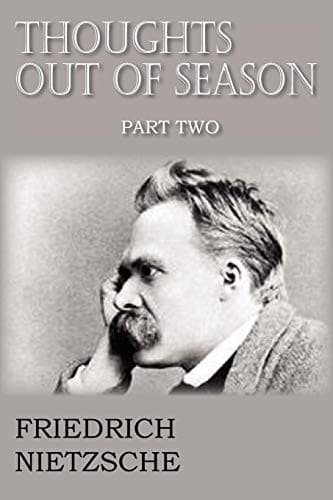
Thoughts Out of Season, Part IINietzsche, Friedrich Wilhelm
PhilosophyPhilosophy
Thoughts Out of Season, Part II
Nietzsche, Friedrich Wilhelm
History -- Study and teaching; Schopenhauer, Arthur, 1788-1860
The vineyard of the Lord! The process! To redemption! Who does not
see and hear in this how historical culture, that only knows the word
"becoming," parodies itself on purpose and says the most
irresponsible things about itself through its grotesque mask? For
what does the rogue mean by this cry to the workers in the vineyard?
By what "work" are they to strive boldly forward? Or, to ask another
question:--what further has the historically educated fanatic of the
world-process to do,--swimming and drowning as he is in the sea of
becoming,--that he may at last gather in that vintage of disgust, the
precious grape of the vineyard? He has nothing to do but to live on
as he has lived, love what he has loved, hate what he has hated, and
read the newspapers he has always read. The only sin is for him to
live otherwise than he has lived. We are told how he has lived, with
monumental clearness, by that famous page with its large typed
sentences, on which the whole rabble of our modern cultured folk have
thrown themselves in blind ecstasy, because they believe they read
their own justification there, haloed with an Apocalyptic light. For
the unconscious parodist has demanded of every one of them, "the full
surrender of his personality to the world-process, for the sake of
his end, the redemption of the world": or still more clearly,--"the
assertion of the will to live is proclaimed to be the first step on
the right road: for it is only in the full surrender to life and its
sorrow, and not in the cowardice of personal renunciation and
retreat, that anything can be done for the world-process.... The
striving for the denial of the individual will is as foolish as it is
useless, more foolish even than suicide.... The thoughtful reader
will understand without further explanation how a practical
philosophy can be erected on these principles, and that such a
philosophy cannot endure any disunion, but only the fullest
reconciliation with life."
Public-domain text, read in full here on John Shaqi.
Reviews
Reviews
No reviews yet
Be the first to share your thoughts on this work.
Join the Discussion
Join the discussion
Sign in to leave a comment or review.
Sign InorCreate an account