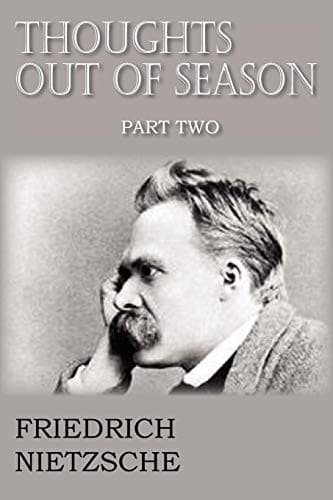
Thoughts Out of Season, Part IINietzsche, Friedrich Wilhelm
PhilosophyPhilosophy
Thoughts Out of Season, Part II
Nietzsche, Friedrich Wilhelm
History -- Study and teaching; Schopenhauer, Arthur, 1788-1860
When they are once understood, no one will take Hartmann's words on
the world-process as anything but a joke. It is, as a fact, high time
to move forward with the whole battalion of satire and malice against
the excesses of the "historical sense," the wanton love of the
world-process at the expense of life and existence, the blind
confusion of all perspective. And it will be to the credit of the
philosopher of the Unconscious that he has been the first to see the
humour of the world-process, and to succeed in making others see it
still more strongly by the extraordinary seriousness of his
presentation. The existence of the "world" and "humanity" need not
trouble us for some time, except to provide us with a good joke: for
the presumption of the small earthworm is the most uproariously comic
thing on the face of the earth. Ask thyself to what end thou art
here, as an individual; and if no one can tell thee, try then to
justify the meaning of thy existence _a posteriori_, by putting
before thyself a high and noble end. Perish on that rock! I know no
better aim for life than to be broken on something great and
impossible, _animæ magnæ prodigus_. But if we have the doctrines of
the finality of "becoming," of the flux of all ideas, types, and
species, of the lack of all radical difference between man and beast
(a true but fatal idea as I think),--if we have these thrust on the
people in the usual mad way for another generation, no one need be
surprised if that people drown on its little miserable shoals of
egoism, and petrify in its self-seeking. At first it will fall
asunder and cease to be a people. In its place perhaps individualist
systems, secret societies for the extermination of non-members, and
similar utilitarian creations, will appear on the theatre of the
future. Are we to continue to work for these creations and write
history from the standpoint of the _masses_; to look for laws in it,
to be deduced from the needs of the masses, the laws of motion of the
lowest loam and clay strata of society? The masses seem to be worth
notice in three aspects only: first as the copies of great men,
printed on bad paper from worn-out plates, next as a contrast to the
great men, and lastly as their tools: for the rest, let the devil and
statistics fly away with them! How could statistics prove that there
are laws in history? Laws? Yes, they may prove how common and
abominably uniform the masses are: and should we call the effects of
leaden folly, imitation, love and hunger--laws? We may admit it: but
we are sure of this too--that so far as there are laws in history,
the laws are of no value and the history of no value either. And
least valuable of all is that kind of history which takes the great
popular movements as the most important events of the past, and
regards the great men only as their clearest expression, the visible
bubbles on the stream. Thus the masses have to produce the great man,
Public-domain text, read in full here on John Shaqi.
Reviews
Reviews
No reviews yet
Be the first to share your thoughts on this work.
Join the Discussion
Join the discussion
Sign in to leave a comment or review.
Sign InorCreate an account