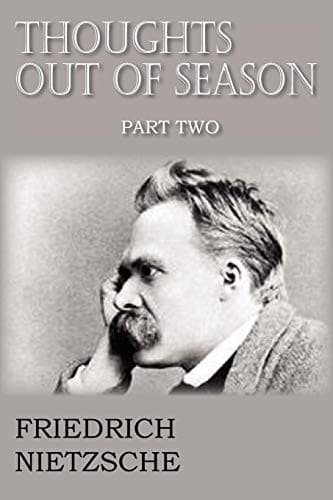
Thoughts Out of Season, Part IINietzsche, Friedrich Wilhelm
PhilosophyPhilosophy
Thoughts Out of Season, Part II
Nietzsche, Friedrich Wilhelm
History -- Study and teaching; Schopenhauer, Arthur, 1788-1860
chaos to bring forth order; and finally all the hymns are naturally
sung to the teeming chaos. Everything is called "great" that has
moved the masses for some long time, and becomes, as they say, a
"historical power." But is not this really an intentional confusion
of quantity and quality? When the brutish mob have found some idea, a
religious idea for example, which satisfies them, when they have
defended it through thick and thin for centuries then, and then only,
will they discover its inventor to have been a great man. The highest
and noblest does not affect the masses at all. The historical
consequences of Christianity, its "historical power," toughness and
persistence prove nothing, fortunately, as to its founder's
greatness, They would have been a witness against him. For between
him and the historical success of Christianity lies a dark heavy
weight of passion and error, lust of power and honour, and the
crushing force of the Roman Empire. From this, Christianity had its
earthly taste, and its earthly foundations too, that made its
continuance in this world possible. Greatness should not depend on
success; Demosthenes is great without it. The purest and noblest
adherents of Christianity have always doubted and hindered, rather
than helped, its effect in the world, its so-called "historical
power"; for they were accustomed to stand outside the "world," and
cared little for the "process of the Christian Idea." Hence they have
generally remained unknown to history, and their very names are lost.
In Christian terms the devil is the prince of the world, and the lord
of progress and consequence: he is the power behind all "historical
power," and so will it remain, however ill it may sound to-day in
ears that are accustomed to canonise such power and consequence. The
world has become skilled at giving new names to things and even
baptizing the devil. It is truly an hour of great danger. Men seem to
be near the discovery that the egoism of individuals, groups or
masses has been at all times the lever of the "historical movements":
and yet they are in no way disturbed by the discovery, but proclaim
that "egoism shall be our god." With this new faith in their hearts,
they begin quite intentionally to build future history on egoism:
though it must be a clever egoism, one that allows of some
limitation, that it may stand firmer; one that studies history for
the purpose of recognising the foolish kind of egoism. Their study
has taught them that the state has a special mission in all future
egoistic systems: it will be the patron of all the clever egoisms, to
protect them with all the power of its military and police against
the dangerous outbreaks of the other kind. There is the same idea in
introducing history--natural as well as human history--among the
labouring classes, whose folly makes them dangerous. For men know
well that a grain of historical culture is able to break down the
Public-domain text, read in full here on John Shaqi.
Reviews
Reviews
No reviews yet
Be the first to share your thoughts on this work.
Join the Discussion
Join the discussion
Sign in to leave a comment or review.
Sign InorCreate an account