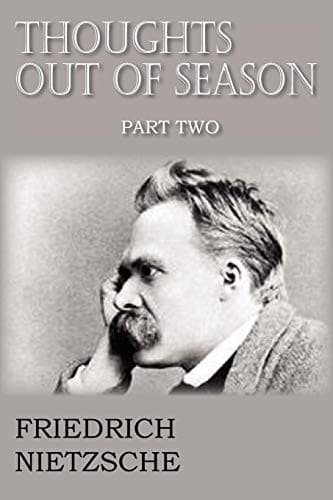
Thoughts Out of Season, Part IINietzsche, Friedrich Wilhelm
PhilosophyPhilosophy
Thoughts Out of Season, Part II
Nietzsche, Friedrich Wilhelm
History -- Study and teaching; Schopenhauer, Arthur, 1788-1860
The voyage was dangerous and exciting. How far are we even now from
that quiet state of contemplation with which we first saw our ship
launched! In tracking out the dangers of history, we have found
ourselves especially exposed to them. We carry on us the marks of
that sorrow which an excess of history brings in its train to the men
of the modern time. And this present treatise, as I will not attempt
to deny, shows the modern note of a weak personality in the
intemperateness of its criticism, the unripeness of its humanity, in
the too frequent transitions from irony to cynicism, from arrogance
to scepticism. And yet I trust in the inspiring power that directs my
vessel instead of genius; I trust in _youth_, that has brought me on
the right road in forcing from me a protest against the modern
historical education, and a demand that the man must learn to live,
above all, and only use history in the service of the life that he
has learned to live. He must be young to understand this protest; and
considering the premature grayness of our present youth, he can
scarcely be young enough if he would understand its reason as well.
An example will help me. In Germany, not more than a century ago, a
natural instinct for what is called "poetry" was awakened in some
young men. Are we to think that the generations who had lived before
that time had not spoken of the art, however really strange and
unnatural it may have been to them? We know the contrary; that they
had thought, written, and quarrelled about it with all their
might--in "words, words, words." Giving life to such words did not
prove the death of the word-makers; in a certain sense they are
living still. For if, as Gibbon says, nothing but time--though a long
time--is needed for a world to perish, so nothing but time--though
still more time--is needed for a false idea to be destroyed in
Germany, the "Land of Little-by-little." In any event, there are
perhaps a hundred men more now than there were a century ago who know
what poetry is: perhaps in another century there will be a hundred
more who have learned in the meantime what culture is, and that the
Germans have had as yet no culture, however proudly they may talk
about it. The general satisfaction of the Germans at their culture
will seem as foolish and incredible to such men as the once lauded
classicism of Gottsched, or the reputation of Ramler as the German
Pindar, seemed to us. They will perhaps think this "culture" to be
merely a kind of knowledge about culture, and a false and superficial
knowledge at that. False and superficial, because the Germans endured
the contradiction between life and knowledge, and did not see what
was characteristic in the culture of really educated peoples, that it
can only rise and bloom from life. But by the Germans it is worn like
a paper flower, or spread over like the icing on a cake; and so must
remain a useless lie for ever.
Public-domain text, read in full here on John Shaqi.
Reviews
Reviews
No reviews yet
Be the first to share your thoughts on this work.
Elsewhere in the archive
Join the Discussion
Join the discussion
Sign in to leave a comment or review.
Sign InorCreate an account