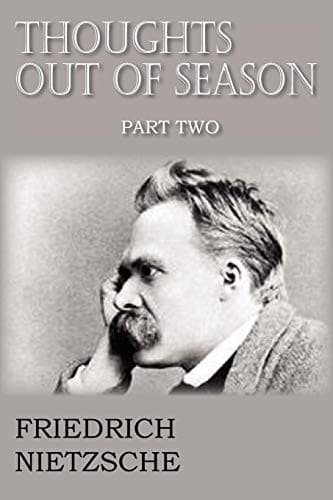
Thoughts Out of Season, Part IINietzsche, Friedrich Wilhelm
PhilosophyPhilosophy
Thoughts Out of Season, Part II
Nietzsche, Friedrich Wilhelm
History -- Study and teaching; Schopenhauer, Arthur, 1788-1860
The education of youth in Germany starts from this false and
unfruitful idea of culture. Its aim, when faced squarely, is not to
form the liberally educated man, but the professor, the man of
science, who wants to be able to make use of his science as soon as
possible, and stands on one side in order to see life clearly. The
result, even from a ruthlessly practical point of view, is the
historically and æsthetically trained Philistine, the babbler of old
saws and new wisdom on Church, State and Art, the sensorium that
receives a thousand impressions, the insatiable belly that yet knows
not what true hunger and thirst is. An education with such an aim and
result is against nature. But only he who is not quite drowned in it
can feel that; only youth can feel it, because it still has the
instinct of nature, that is the first to be broken by that education.
But he who will break through that education in his turn, must come
to the help of youth when called upon; must let the clear light of
understanding shine on its unconscious striving, and bring it to a
full, vocal consciousness. How is he to attain such a strange end?
Principally by destroying the superstition that this kind of
education is _necessary_. People think nothing but this troublesome
reality of ours is possible. Look through the literature of higher
education in school and college for the last ten years, and you will
be astonished--and pained--to find how much alike all the proposals
of reform have been; in spite of all the hesitations and violent
controversies surrounding them. You will see how blindly they have
all adopted the old idea of the "educated man" (in our sense) being
the necessary and reasonable basis of the system. The monotonous
canon runs thus: the young man must begin with a knowledge of
culture, not even with a knowledge of life, still less with life and
the living of it. This knowledge of culture is forced into the young
mind in the form of historical knowledge; which means that his head
is filled with an enormous mass of ideas, taken second-hand from past
times and peoples, not from immediate contact with life. He desires
to experience something for himself, and feel a close-knit, living
system of experiences growing within himself. But his desire is
drowned and dizzied in the sea of shams, as if it were possible to
sum up in a few years the highest and notablest experiences of
ancient times, and the greatest times too. It is the same mad method
that carries our young artists off to picture-galleries, instead of
the studio of a master, and above all the one studio of the only
master, Nature. As if one could discover by a hasty rush through
history the ideas and technique of past times, and their individual
outlook on life! For life itself is a kind of handicraft that must be
learned thoroughly and industriously, and diligently practised, if we
are not to have mere botchers and babblers as the issue of it all!
Public-domain text, read in full here on John Shaqi.
Reviews
Reviews
No reviews yet
Be the first to share your thoughts on this work.
Elsewhere in the archive
Join the Discussion
Join the discussion
Sign in to leave a comment or review.
Sign InorCreate an account