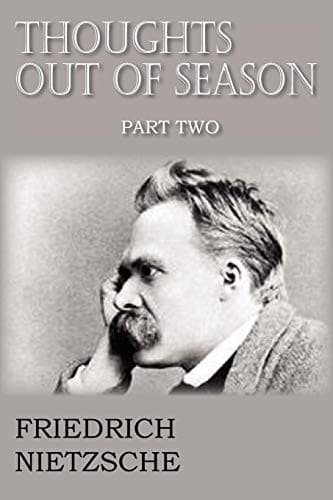
Thoughts Out of Season, Part IINietzsche, Friedrich Wilhelm
PhilosophyPhilosophy
Thoughts Out of Season, Part II
Nietzsche, Friedrich Wilhelm
History -- Study and teaching; Schopenhauer, Arthur, 1788-1860
Plato thought it necessary for the first generation of his new
society (in the perfect state) to be brought up with the help of a
"mighty lie." The children were to be taught to believe that they had
all lain dreaming for a long time under the earth, where they had
been moulded and formed by the master-hand of Nature. It was
impossible to go against the past, and work against the work of gods!
And so it had to be an unbreakable law of nature, that he who is born
to be a philosopher has gold in his body, the fighter has only
silver, and the workman iron and bronze. As it is not possible to
blend these metals, according to Plato, so there could never be any
confusion between the classes: the belief in the _æterna veritas_ of
this arrangement was the basis of the new education and the new
state. So the modern German believes also in the _æterna veritas_ of
his education, of his kind of culture: and yet this belief will
fail--as the Platonic state would have failed--if the mighty German
lie be ever opposed by the truth, that the German has no culture
because he cannot build one on the basis of his education. He wishes
for the flower without the root or the stalk; and so he wishes in
vain. That is the simple truth, a rude and unpleasant truth, but yet
a mighty one.
But our first generation must be brought up in this "mighty truth,"
and must suffer from it too; for it must educate itself through it,
even against its own nature, to attain a new nature and manner of
life, which shall yet proceed from the old. So it might say to
itself, in the old Spanish phrase, "Defienda me Dios de my," God keep
me from myself, from the character, that is, which has been put into
me. It must taste that truth drop by drop, like a bitter, powerful
medicine. And every man in this generation must subdue himself to
pass the judgment on his own nature, which he might pass more easily
on his whole time:--"We are without instruction, nay, we are too
corrupt to live, to see and hear truly and simply, to understand what
is near and natural to us. We have not yet laid even the foundations
of culture, for we are not ourselves convinced that we have a sincere
life in us." We crumble and fall asunder, our whole being is divided,
half mechanically, into an inner and outer side; we are sown with
ideas as with dragon's teeth, and bring forth a new dragon-brood of
them; we suffer from the malady of words, and have no trust in any
feeling that is not stamped with its special word. And being such a
dead fabric of words and ideas, that yet has an uncanny movement in
it, I have still perhaps the right to say _cogito ergo sum_, though
not _vivo ergo cogito_. I am permitted the empty _esse_, not the full
green _vivere_. A primary feeling tells me that I am a thinking being
but not a living one, that I am no "animal," but at most a "cogital."
"Give me life, and I will soon make you a culture out of it"--will be
the cry of every man in this new generation, and they will all know
Public-domain text, read in full here on John Shaqi.
Reviews
Reviews
No reviews yet
Be the first to share your thoughts on this work.
Elsewhere in the archive
Join the Discussion
Join the discussion
Sign in to leave a comment or review.
Sign InorCreate an account