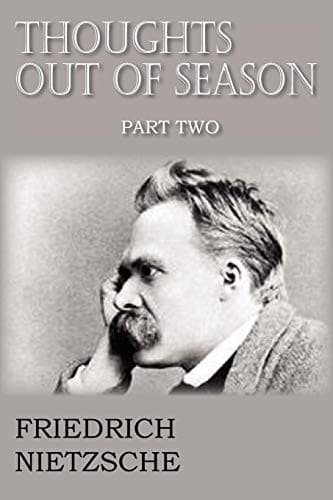
Thoughts Out of Season, Part IINietzsche, Friedrich Wilhelm
PhilosophyPhilosophy
Thoughts Out of Season, Part II
Nietzsche, Friedrich Wilhelm
History -- Study and teaching; Schopenhauer, Arthur, 1788-1860
while all the clever people cannot escape the error of thinking one
comes nearer to the interpretation by a laborious analysis of the
colours and material of the picture; with the confession, probably,
that the texture of the canvas is very complicated, and the chemical
composition of the colours undiscoverable. Schopenhauer knew that one
must guess the painter in order to understand the picture. But now
the whole learned fraternity is engaged on understanding the colours
and canvas, and not the picture: and only he who has kept the
universal panorama of life and being firmly before his eyes, will use
the individual sciences without harm to himself; for, without this
general view as a norm, they are threads that lead nowhere and only
confuse still more the maze of our existence. Here we see, as I said,
the greatness of Schopenhauer, that he follows up every idea, as
Hamlet follows the Ghost, without allowing himself to turn aside for
a learned digression, or be drawn away by the scholastic abstractions
of a rabid dialectic. The study of the minute philosophers is only
interesting for the recognition that they have reached those stages
in the great edifice of philosophy where learned disquisitions for
and against, where hair-splitting objections and counter-objections
are the rule: and for that reason they evade the demand of every
great philosophy to speak _sub specie æternitatis_--"this is the
picture of the whole of life: learn thence the meaning of thine own
life." And the converse: "read thine own life, and understand thence
the hieroglyphs of the universal life." In this way must
Schopenhauer's philosophy always be interpreted; as an individualist
philosophy, starting from the single man, in his own nature, to gain
an insight into his personal miseries, and needs, and limitations,
and find out the remedies that will console them: namely, the
sacrifice of the ego, and its submission to the nobler ends,
especially those of justice and mercy. He teaches us to distinguish
between the true and the apparent furtherance of man's happiness: how
neither the attainment of riches, nor honour, nor learning, can raise
the individual from his deep despair at his unworthiness; and how the
quest for these good things can only have meaning through a universal
end that transcends and explains them;--the gaining of power to aid
our physical nature by them and, as far as may be, correct its folly
and awkwardness. For one's self only, in the first instance: and
finally, through one's self, for all. It is a task that leads to
scepticism: for there is so much to be made better yet, in one and
all!
Public-domain text, read in full here on John Shaqi.
Reviews
Reviews
No reviews yet
Be the first to share your thoughts on this work.
Elsewhere in the archive
Join the Discussion
Join the discussion
Sign in to leave a comment or review.
Sign InorCreate an account