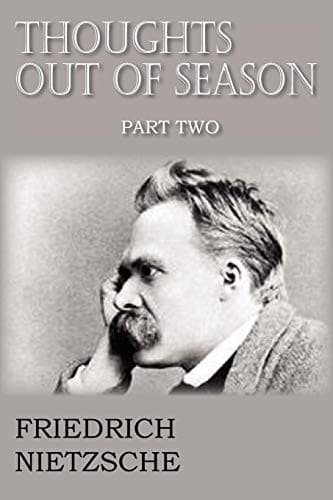
Thoughts Out of Season, Part IINietzsche, Friedrich Wilhelm
PhilosophyPhilosophy
Thoughts Out of Season, Part II
Nietzsche, Friedrich Wilhelm
History -- Study and teaching; Schopenhauer, Arthur, 1788-1860
The more one considers these three dangers, the more extraordinary
will appear his vigour in opposing them and his safety after the
battle. True, he gained many scars and open wounds: and a cast of
mind that may seem somewhat too bitter and pugnacious. But his single
ideal transcends the highest humanity in him. Schopenhauer stands as
a pattern to men, in spite of all those scars and scratches. We may
even say, that what was imperfect and "all too human" in him, brings
us nearer to him as a man, for we see a sufferer and a kinsman to
suffering, not merely a dweller on the unattainable heights of
genius.
These three constitutional dangers that threatened Schopenhauer,
threaten us all. Each one of us bears a creative solitude within
himself and his consciousness of it forms an exotic aura of
strangeness round him. Most men cannot endure it, because they are
slothful, as I said, and because their solitude hangs round them a
chain of troubles and burdens. No doubt, for the man with this heavy
chain, life loses almost everything that one desires from it in
youth--joy, safety, honour: his fellow-men pay him his due
of--isolation! The wilderness and the cave are about him, wherever he
may live. He must look to it that he be not enslaved and oppressed,
and become melancholy thereby. And let him surround himself with the
pictures of good and brave fighters such as Schopenhauer.
The second danger, too, is not rare. Here and there we find one
dowered by nature with a keen vision; his thoughts dance gladly in
the witches' Sabbath of dialectic; and if he uncautiously give his
talent the rein, it is easy to lose all humanity and live a ghostly
life in the realm of "pure reason": or through the constant search
for the "pros and cons" of things, he may go astray from the truth
and live without courage or confidence, in doubt, denial and
discontent, and the slender hope that waits on disillusion: "No dog
could live long thus!"
The third danger is a moral or intellectual hardening: man breaks the
bond that united him to his ideal: he ceases to be fruitful and
reproduce himself in this or that province, and becomes an enemy or a
parasite of culture. The solitude of his being has become an
indivisible, unrelated atom, an icy stone. And one can perish of this
solitude as well as of the fear of it, of one's self as well as one's
self-sacrifice, of both aspiration and petrifaction: and to live is
ever to be in danger.
Public-domain text, read in full here on John Shaqi.
Reviews
Reviews
No reviews yet
Be the first to share your thoughts on this work.
Elsewhere in the archive
Join the Discussion
Join the discussion
Sign in to leave a comment or review.
Sign InorCreate an account